Rank #1 in Google: Does It Still Mean You Win?
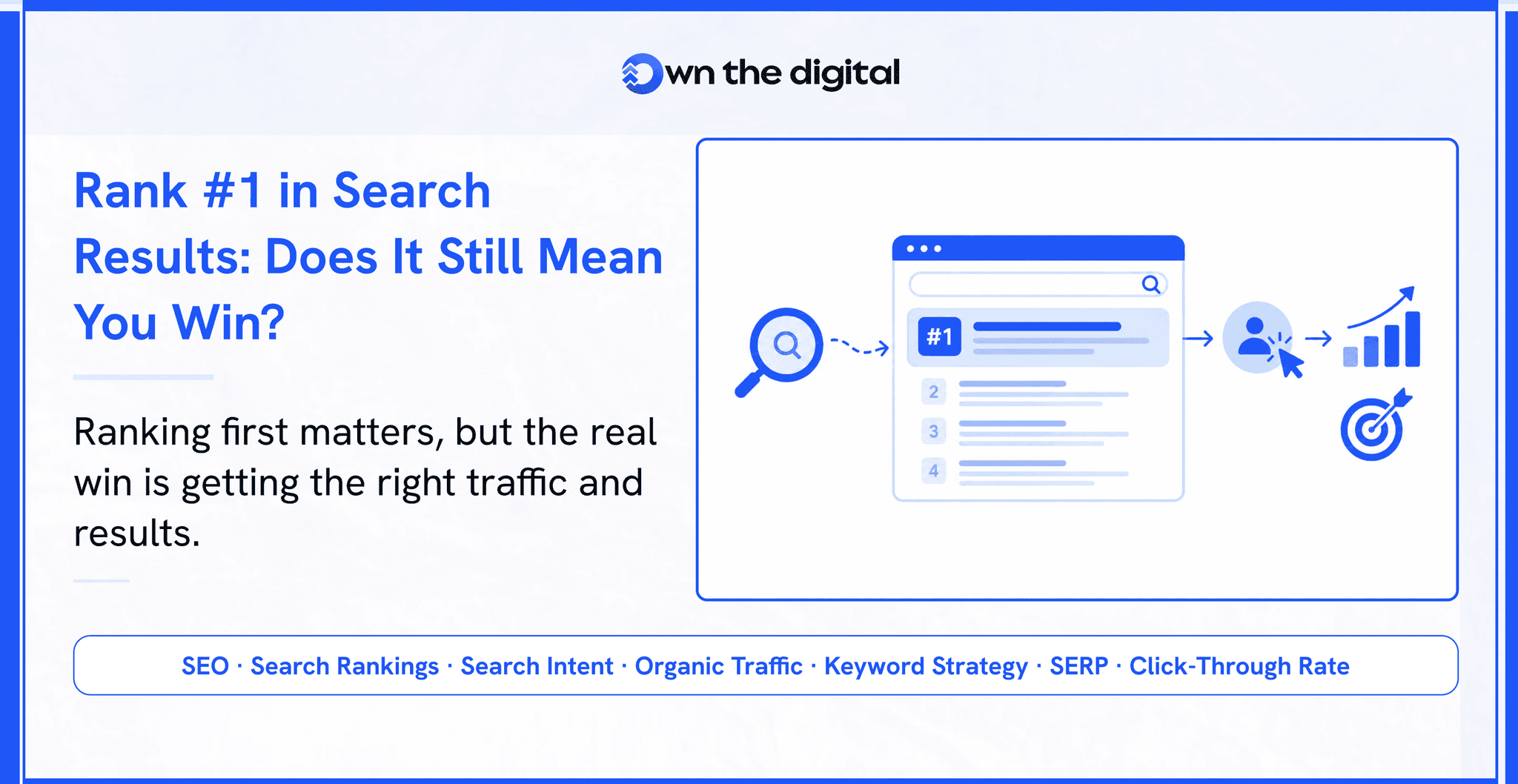
Ranking first matters, but relevant traffic, qualified leads, and conversions determine the real value of SEO.
A professional digital marketing visual illustrating how SEO performance goes beyond ranking first on Google. The image represents search visibility, keyword relevance, organic clicks, qualified website visitors, and conversions as connected measures of business growth.
Ranking first on Google can increase visibility, but it doesn't guarantee business success. Discover why search intent, relevant traffic, click-through rates, and conversions matter more than rankings alone.
Ranking first on Google has been the ultimate SEO goal for years. Businesses invest months in creating content, improving websites, building backlinks, and targeting keywords. Their objective is simple: reach the number-one position.
That goal makes sense. The first result attracts attention before the listings below it. It often has a better chance of earning a click and can create a strong impression of authority. However, position one does not guarantee success. A website can rank first and still receive fewer meaningful visitors than expected. It can attract people who want something different or generate traffic that never turns into a lead, enquiry, or purchase.
Meanwhile, a lower-ranking result can attract more attention because its title, description, or offer better matches the searcher's needs. So the question is no longer simply, "How do we rank #1?" It is, "What happens after we reach #1?"
What Does Ranking #1 Actually Mean?
When a page ranks #1 for a search query, it appears as the leading organic result for that particular search at that moment. However, search results do not look identical for everyone. Google considers the query, location, device, search intent, and other contextual signals when selecting results. Your position can change across search variations, locations, and devices. Search features can also occupy valuable space above traditional organic listings.
Why Rankings Need Context
A report stating that your website ranks first for 50 keywords does not tell the complete story. Some keywords may attract potential customers, while others bring visitors with little interest in your services.
The more useful question is whether those rankings represent searches that matter to your business.
The Keyword Matters More Than the Position
Not all number-one rankings offer the same value. Imagine a company that sells premium website development services.
Ranking first for "what is website development" might generate substantial traffic. However, many visitors may only want to learn about the topic.
Now compare that keyword with "custom software development company for startups." The second query might receive fewer searches, but its audience may include businesses actively looking for a provider.
Understand Search Intent
Search intentexplains what people want to accomplish when they enter a query. Understanding that intent helps you target keywords that align with your business goals.
- Informational intent: People want to learn about a topic or find an answer.
- Navigational intent: People want to find a specific website, brand, or service.
- Commercial intent: People compare products, services, or providers before deciding.
- Transactional intent: People are ready to take action, such as buying a product or requesting a service.
Ranking first for the wrong type of search can produce impressive traffic numbers without meaningful business results. Evaluate each keyword by its intent and potential value, not just its search volume.
Search Volume Can Be Misleading
High search volume looks attractive in an SEO strategy. A keyword with tens of thousands of monthly searches appears to offer a significant opportunity. However, search volume alone cannot tell you how valuable that traffic will be.
A broad keyword can attract people with very different needs. A specific keyword may generate fewer visits but attract people who are much more likely to become customers.
For example, "digital marketing" can represent research, education, job searches, or service discovery. By comparison, "performance marketing agency for ecommerce" communicates a much more specific need.
Balance Search Demand and Business Value
Specific searches can reveal stronger commercial intent. They help you connect your services with people who already understand what they need.
SEO should therefore focus on the relationship between search demand, intent, and business value. Chasing the biggest number in a keyword tool can waste time and resources if the audience does not match your target customers.
Being #1 Does Not Guarantee the Click
Even when your page appears first, the searcher still has to choose it. The search engine results page, commonly called the SERP, may contain advertisements, maps, videos, featured snippets, product listings, image results, and AI-generated answers.
These elements can compete for attention and push traditional organic listings further down the page.
Make Your Search Listing More Compelling
Your title and description also influence whether people visit your website. Consider two results that appear in the first and second positions.
The first uses a generic title that simply repeats the keyword. The second clearly explains what the page offers and why it helps the reader. The second result may attract more clicks despite ranking lower. This is why SEO does not stop at rankings. You need visibility first, but you must also give searchers a reason to click.
What Happens After the Click?
Suppose your website finally reaches position one. Organic traffic increases, sessions rise, and your monthly report looks impressive. However, enquiries remain unchanged.
That gap deserves attention. You need to understand what visitors experience after they arrive. A page can rank well but still perform poorly if it fails to satisfy search intent. Visitors may expect one thing and find something completely different. Slow loading times, unclear calls to action, and confusing layouts can also discourage them from taking the next step.
Turn Relevant Traffic Into Results
Commercial visitors often need a clear reason to choose your company. Your page should explain the value of your service, answer important questions, establish trust, and guide readers toward an appropriate next step.
Ranking brings visitors to your website. Your content and user experience must then help them find what they need.
Search Intent Should Shape the Page
One common SEO mistake is creating a page around a keyword without examining the results Google already displays for that search.
The SERP often provides useful clues about what searchers expect. If educational guides dominate the first page, the query likely has a strong informational component. If product pages, comparison articles, and service providers dominate the results, searchers may be closer to making a decision.
Match the Content Format to the Query
A sales-focused service page may struggle to rank for a query where users clearly want an educational guide. Repeating the keyword more often will not solve that mismatch.
Instead, align the page with the reason behind the search. You may need to change its format, depth, examples, structure, or overall purpose. When your content matches user expectations, you give it a stronger foundation for competing in organic search.
Content Quality Still Matters After You Reach the Top
Reaching page one does not end the content challenge. Search behaviour changes, competitors publish new pages, and user expectations evolve.
A page that answered a query effectively two years ago may no longer provide the most useful information today. High-ranking content therefore needs regular review and improvement.
Keep High-Ranking Content Relevant
Review your content regularly and look for opportunities to improve its usefulness.
- Update outdated information and examples.
- Improve sections that no longer answer the question properly.
- Add useful information that readers now expect.
- Remove unnecessary content that makes the page difficult to navigate.
- Check links, factual claims, and calls to action.
Do not make an article longer simply because competing pages contain more words. Focus on answering the searcher's question clearly and thoroughly.
Why One #1 Keyword Is Not Enough
Most websites benefit from targeting a range of relevant keywords rather than relying on one phrase. People search in different ways as they learn about a problem, compare options, and prepare to make a decision.
For example, someone researching digital advertising might move through several searches:
- "What is performance marketing?"
- "Performance marketing vs digital marketing"
- "Performance marketing agency"
- "Performance marketing agency for ecommerce"
Each query represents a different stage of the decision-making process. An effective SEO strategy builds visibility across this broader journey.
Build Visibility Across the Customer Journey
Informational content can introduce your brand to new audiences. Comparison pages can help people evaluate their options, while service pages can address customers who are ready to enquire. This approach reduces dependence on a single keyword and helps you reach potential customers at different stages of their journey.
The SERP Is Your Real Competition
Many businesses measure SEO competition by looking only at companies in their industry. However, your biggest competitor for a specific query may not be a direct business competitor. It could be a review website, publisher, directory, YouTube video, Reddit discussion, comparison article, government website, or marketplace. What matters is which pages currently satisfy the searcher's intent.
Analyse Search Results Before Creating Content
Before trying to rank first, study the results for your target keyword. Look at the page types, topics, depth, examples, and formats that appear.
Ask yourself a few practical questions:
- What types of pages rank for this query?
- What questions do those pages answer?
- What information do they leave out?
- Which formats best match the searcher's intent?
- How could your page offer more value?
This research gives you a stronger starting point than simply choosing a keyword and writing an article around it.
SEO Rankings Are a Moving Target
A ranking report can make SEO look more static than it really is. You might celebrate a move from position eight to position three, only to see the page return to position five the following week. That movement does not automatically mean your strategy has failed. Search results change as Google evaluates pages, competitors publish content, and user behaviour evolves.
Measure Performance Over Time
Evaluate SEO trends over meaningful periods rather than reacting to isolated ranking snapshots. Review organic impressions, clicks, conversions, and revenue alongside keyword positions. These metrics provide a more complete picture of whether organic visibility contributes to business growth.
Rank #1 for the Searches That Matter
The goal of SEO should not be to collect number-one rankings. It should be to reach potential customers when they search for something your business can genuinely help them with.
That approach changes how you conduct keyword research. Instead of asking only how many people search for a phrase, consider who they are and what they want to accomplish.
Ask the Right Questions Before Targeting a Keyword
- Who is searching for this phrase?
- Why are they searching for it?
- What are they likely to do next?
- Can our business solve their problem?
- Would this traffic create value if we ranked first?
These questions can eliminate a surprising amount of wasted SEO effort. A keyword with 20,000 monthly searches may look impressive, but it may attract few potential customers.
A keyword with 500 searches could prove more valuable if those searchers actively need the service you provide. The best choice depends on intent, competition, conversion potential, and your business objectives.
What Should You Measure Instead of Rankings Alone?
Rankings still matter because they show how well your pages perform in organic search. However, you should evaluate them alongside other metrics that reveal what happens before and after the click.
- Organic impressions: Track how often your pages appear in search results.
- Organic clicks: Measure how many visits those results generate.
- Click-through rate: Understand how often searchers click after seeing your listing.
- Engagement: Examine whether visitors interact with your content and find it useful.
- Leads and enquiries: Connect organic traffic with potential business opportunities.
- Revenue: Assess how SEO contributes to commercial performance.
These measurements help you move beyond rankings and understand the actual value of your organic strategy. Use the metrics together because no single measurement explains every aspect of SEO performance.
The Real Value of Position #1
There is nothing wrong with wanting to rank first. A top position can be valuable when the keyword aligns with your audience and your page satisfies the searcher's intent. The problem starts when the ranking itself becomes the objective. A first-place result that attracts irrelevant traffic may deliver little business value.
Meanwhile, a second-place page that consistently generates qualified enquiries could be more valuable than a first-place result that attracts thousands of unqualified visitors. Search visibility creates an opportunity. Your content needs to earn the click, and your website needs to satisfy the visitor. Your business must then turn the right visits into meaningful outcomes. That is what makes a ranking valuable.
Final Takeaway: Relevance Makes Rankings Valuable
Ranking #1 is a milestone, not a marketing strategy. Strong SEO begins by identifying valuable searches, understanding the people behind them, and creating content that genuinely helps them. Technical optimisation, content improvements, authority building, measurement, and ongoing maintenance then help your pages compete for relevant visibility.
The best ranking is not necessarily the one that brings the most traffic. It is the one that attracts the right traffic and gives those visitors a reason to take the next step. In SEO, being first is useful. Being relevant is what makes it valuable.
Grow Your Organic Traffic with Own The Digital
Improving SEO performance takes more than chasing the top position. Businesses need a strategy that connects keyword research, helpful content, website performance, and conversion goals.
Own The Digital helps businesses strengthen their online presence through digital marketing strategies focused on visibility, audience engagement, and business growth. From SEO and content optimisation to improving website performance, the right approach can help turn search traffic into meaningful opportunities.
Ready to make your website work harder for your business? Connect with Own The Digital to discuss your digital marketing goals and explore strategies tailored to your business needs.