Search Volume: What It Means and Why It Matters in SEO
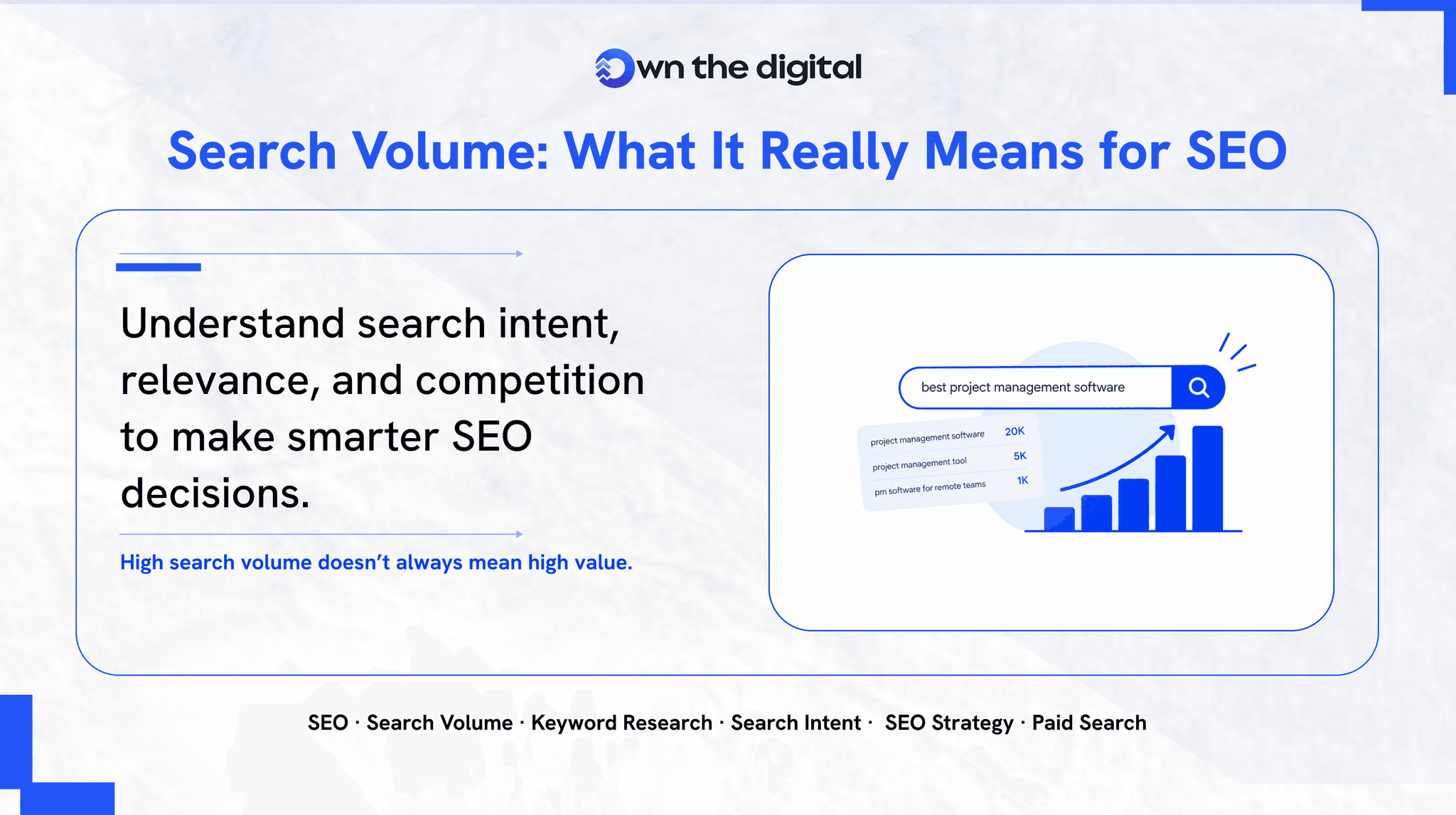
Search volume helps marketers understand keyword demand and identify relevant SEO opportunities.
A visual representation of search volume and keyword research, illustrating how marketers evaluate search demand, compare keyword opportunities, and plan SEO and performance marketing strategies.
Understand what search volume means and how it influences keyword research, SEO strategy, search intent, and paid advertising. Discover why high search volume does not always translate into better traffic, leads, or revenue.
A keyword can look like the perfect opportunity on paper. It may have thousands of searches every month, appear relevant to your business, and sit at the centre of what your audience seems to be looking for. But search volume alone cannot tell you whether a keyword will bring the right visitors, generate enquiries, or contribute to revenue.
Understanding search volume helps marketers estimate demand, compare keywords, identify content opportunities, and decide where their SEO and advertising budgets deserve attention. The key is knowing what the number represents, how it is estimated, and what it cannot tell you.
What Is Search Volume?
Search volume refers to the estimated number of times a particular keyword or search query is searched within a specific period, usually a month. When SEO tools display monthly search volume, they provide an estimate of the search activity associated with that term.
For example, a keyword with an estimated monthly search volume of 20,000 indicates considerably more search activity than a keyword with a volume of 200. However, this does not necessarily mean that 20,000 individual people are searching for it. The same person may search multiple times, and behaviour can change depending on season, location, device, current events, and query wording.
Search volume is therefore best treated as an indicator of demand rather than an exact count of potential customers.
This distinction matters because a large number does not automatically represent a large business opportunity. A high-volume keyword may attract people looking for general information, while a lower-volume keyword may come from users who are closer to making a purchase.
For example, someone searching for "what is performance marketing" has a different objective from someone searching for "performance marketing agency for ecommerce." Both searches can be valuable, but their commercial relevance may differ significantly.
Why Search Volume Matters in SEO
Search volume gives marketers a starting point for understanding what people are actively looking for. Before creating a landing page, writing a blog post, or developing a content cluster, businesses need some indication that their audience is interested in the topic.
Search volume can help identify topics with sufficient demand and reveal keyword variations that may be relevant to an audience. It can also inform the structure of an SEO strategy.
For example, a business planning content around paid advertising could research related queries such as:
- Google Ads
- Google Ads cost
- Google Ads conversion tracking
- Google Ads for small business
These search terms can reveal different audience needs. Search volume does not automatically determine what a business should publish, but it helps identify where demand exists. Search intent, competition, business relevance, and conversion potential then help determine which topics deserve priority.
This is particularly useful when resources are limited. Search data helps businesses make content planning more deliberate rather than relying entirely on assumptions.
High Search Volume Does Not Always Mean High Value
One of the most common mistakes in keyword research is assuming that a keyword with the highest search volume should automatically receive the most attention. This can lead to a website attracting traffic with little commercial value.
Imagine a software company that sells project management software. The keyword "project management" may have substantial search demand, but it is broad. People searching for it could be students, professionals researching the subject, managers comparing tools, or businesses looking for software.
A more specific query, such as "project management software for remote teams," may have lower search volume but a clearer connection to the product being offered.
This is why keyword selection should consider more than volume. Search intent, relevance, competition, conversion potential, and the buyer journey all influence whether a keyword is worth pursuing.
Search Volume and Search Intent Need to Work Together
Search intent describes what a person is trying to accomplish when entering a query into a search engine. It is commonly grouped into four categories:
- Informational intent: The user wants to learn something or find an answer.
- Navigational intent: The user wants to find a specific website or brand.
- Commercial investigation: The user is researching and comparing potential solutions.
- Transactional intent: The user is ready to take an action, such as buying a product or requesting a service.
Search volume tells you how much activity exists around a query, while search intent provides context about that activity.
Consider the difference between "Instagram marketing ideas" and "Instagram marketing agency." The first query may attract someone researching strategies or collecting ideas. The second suggests that the user may be evaluating a service provider.
A strong SEO strategy maps keywords to the questions, problems, comparisons, and decisions that matter to the audience. This helps create content that serves a clear purpose beyond attracting visitors.
How Monthly Search Volume Is Estimated
Search volume displayed by SEO platforms is generally an estimate, not a guaranteed count. Different tools can produce different figures because they use different datasets, methodologies, geographic settings, and calculation models.
Search behaviour can also fluctuate throughout the year. Keywords related to gifts, travel, education, tax filing, and seasonal shopping may experience significant changes in demand depending on the time of year.
Location and Search Demand
Location is another important factor. A keyword might have strong demand across India but much lower demand within a particular city. The same principle applies to international markets. Businesses serving customers in one location should not automatically interpret global search volume as their available local audience.
Keyword Variations
People may search for the same solution using different phrases. One user might search for "social media agency," another for "social media marketing company," and another for a longer query describing exactly what they need.
Reviewing related keyword variations can provide a more realistic picture of overall demand than focusing on one phrase in isolation.
How to Use Search Volume During Keyword Research
The most useful way to use search volume is as one input in a broader keyword evaluation process.
- Identify relevant keywords: Start with terms connected to your business, services, customer problems, and expertise.
- Compare search demand: Review estimated search volume across relevant keywords and variations.
- Evaluate search intent: Determine whether users want information, comparisons, a specific website, or a product or service.
- Assess competition: Review keyword difficulty and examine the websites already ranking in search results.
- Consider business value: Prioritize terms that align with your audience, offer, and conversion goals.
- Group related keywords: Build useful pages around related topics instead of creating thin articles for every variation.
It is also worth studying the search engine results page (SERP). If a keyword has substantial volume but the results are dominated by established websites, major publications, marketplaces, or highly authoritative domains, ranking for it may require considerable effort.
A lower-volume keyword with clearer intent and more attainable competition may offer a more practical starting point.
Grouping related keywords into topics can also improve content planning. Several queries may represent different ways of asking the same question. One genuinely useful page that addresses the broader topic may be more effective than several thin articles created simply because each keyword has its own search volume figure.
Search Volume for Paid Advertising
Search volume is useful beyond organic SEO. It can also provide context for paid search campaigns by helping advertisers understand whether there is existing demand around a product, service, or problem.
However, search volume should not be mistaken for guaranteed advertising results. A keyword can have substantial search demand and still generate expensive clicks, weak conversion rates, or poor-quality leads.
Cost per click, competition, landing page experience, offer strength, conversion tracking, and audience fit all influence campaign performance.
When expanding a paid search campaign, marketers should examine which queries generate meaningful actions and compare those results with the available demand. The goal is not to buy the largest possible amount of traffic. It is to identify demand that has a reasonable connection to the business outcome being measured.
What Search Volume Cannot Tell You
Search volume can indicate that search activity exists. It cannot tell you exactly why every person is searching, how many people will click your result, how many visitors will convert, or how much revenue a keyword will generate.
It also cannot guarantee that a page will rank simply because a keyword appears in its content.
Traffic without relevance can increase website visits without improving leads or sales. Meanwhile, specific searches with modest volume may attract users who are much closer to taking action.
Instead of asking, "Which keyword has the highest search volume?" ask a more useful question: "Which search demand is relevant to the people we want to reach, and can our business genuinely satisfy that demand?"
Turning Search Data Into a Marketing Strategy
Search volume becomes valuable when it informs real decisions. It can help businesses discover what audiences are searching for, identify content gaps, understand demand around products or services, and prioritize topics for organic and paid campaigns.
At OTD, we look at search behaviour in the context of the larger marketing system. A keyword needs to make sense for the audience, the offer, the landing experience, and the business objective. That means looking beyond how many times a phrase is searched and asking what happens after someone clicks.
The real value of search marketing is not simply getting your brand in front of more searches. It is connecting the right search with the right message, the right page, and the right next step.
Search volume can show where demand exists. Strategy determines what you do with it.