Search Intent in Google Ads: Why Clicks Don't Convert
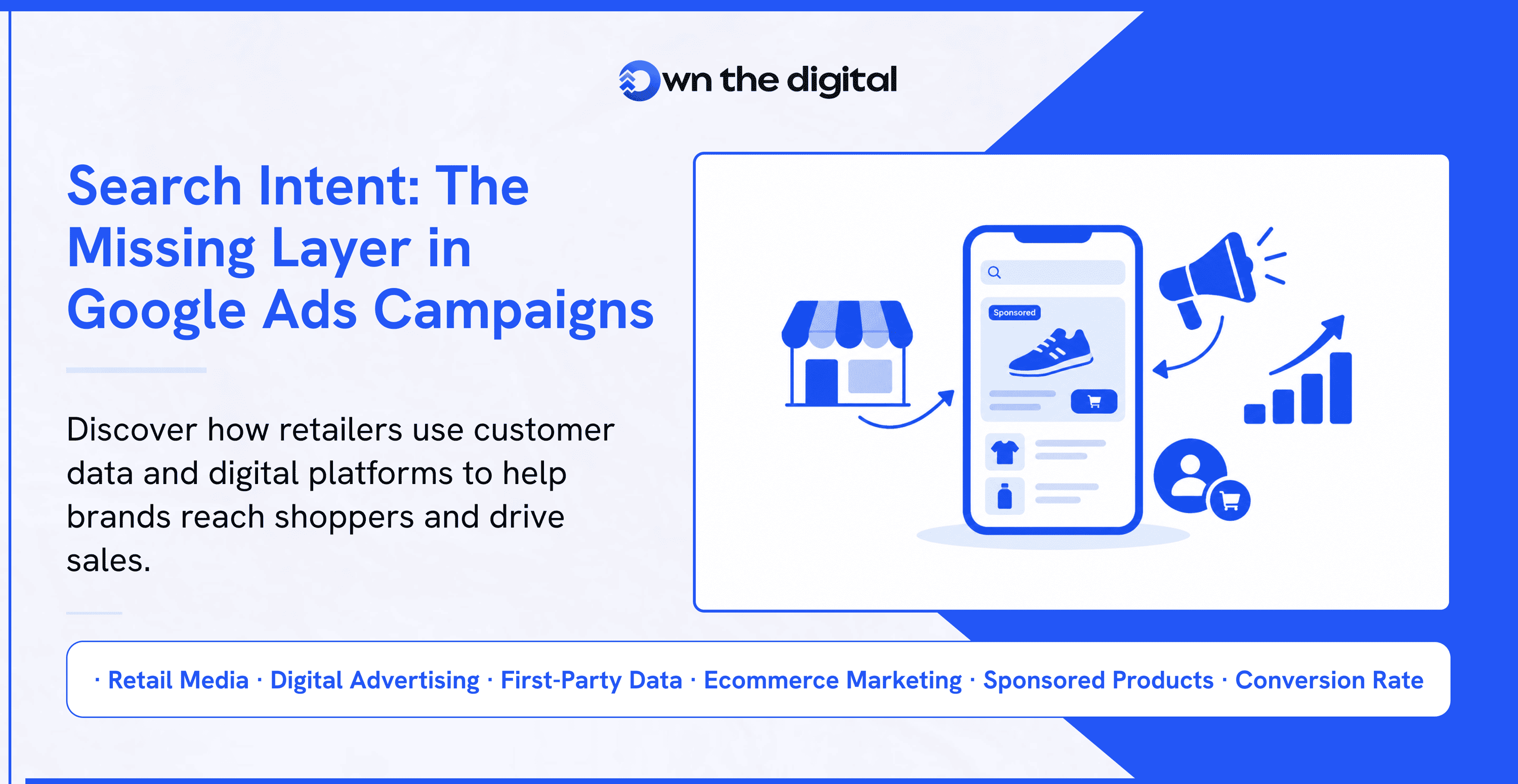
Understanding search intent helps businesses attract more relevant clicks and better-quality leads.
A digital marketing visual representing search intent in Google Ads, highlighting how user search behaviour influences keyword targeting, ad relevance, traffic quality and conversions.
Getting clicks but not enough customers from Google Ads? Search intent could be the missing layer. Understand how user intent influences keyword selection, ad copy, landing pages and campaign performance.
A Google Ads campaign can have relevant keywords, a good click-through rate and a controlled cost per click, yet still struggle to generate actual customers. When that happens, the problem is not always the bidding strategy, ad copy or budget. Sometimes the missing layer is much simpler: understanding why people are searching in the first place.
Search intent is the reason behind a user’s search. It tells you what someone is actually trying to accomplish when they type a query into Google. Are they looking for information? Comparing different options? Trying to find a specific company? Or are they already ready to buy? These differences matter because two people can search for closely related terms while being at completely different stages of the buying journey.
This is where many Google Ads campaigns go wrong. They are built around what people search for, but not necessarily what those searches mean. A keyword can be highly relevant to your business and still bring traffic that has very little chance of becoming a customer. When campaigns focus primarily on keywords, clicks and CPC, they can miss the much more important question: what does this search tell us about the person behind it?
Why Keywords Alone Don’t Tell the Whole Story
Consider a company offering accounting software. Someone searching for “what is accounting software” is probably trying to understand the category. Another person searching for “best accounting software for small business” is evaluating different options. Someone searching for “accounting software pricing” may already be considering a purchase, while a search such as “buy accounting software” carries an even stronger commercial signal.
All four searches are related to the same product. But they do not represent the same opportunity.
If the campaign treats all these searches in exactly the same way, it may spend money reaching people who are still researching when the business is actually trying to generate immediate enquiries or sales. The issue is not necessarily that the traffic is irrelevant. The issue is that the campaign is failing to distinguish between different levels and types of intent.
This distinction becomes even more important for service businesses. Someone searching for “digital marketing agency” could be a business owner looking for an agency, a student researching the industry, someone looking for a job, or a person trying to understand what a digital marketing agency does. The keyword looks relevant in every case. The commercial value is not the same.
Search Intent Changes the Value of a Click
One of the biggest mistakes in paid search is assuming that every click has roughly the same value. It doesn’t.
A person searching “how does Google Ads work” may be interested in the subject but have no intention of hiring an agency. Someone searching “Google Ads agency for ecommerce” has already moved closer to a commercial decision. A person searching “Google Ads management pricing” may be even further down the buying journey.
The advertiser pays for each click, but the probability of conversion behind those clicks can be dramatically different.
This is why a campaign can have plenty of traffic and still fail to generate enough business. The campaign may be efficient at buying clicks without being equally efficient at buying commercial intent.
For businesses, the difference is significant. Ten clicks from people actively looking for a service can be more valuable than a hundred clicks from people who are simply researching the topic.
The Search Terms Report Can Reveal the Real Problem
Your keyword list tells you what you intended to target. Your search terms report can tell you what people actually searched before clicking your ad.
That distinction is important.
Suppose a business is running Google Ads around the keyword “digital marketing agency.” On the surface, that seems like a strong commercial keyword. But after looking at the actual search terms, the campaign might be attracting searches such as “digital marketing agency course,” “digital marketing agency jobs,” “how to start a digital marketing agency,” “what does a digital marketing agency do” and “best digital marketing agency for ecommerce.”
These searches may all contain the same core phrase, but the intent behind them is completely different.
Some people are looking for education. Some are looking for employment. Some are exploring how to start a business. Others are evaluating agencies they could potentially hire.
If you only look at keyword-level performance, these differences can remain hidden.
This is why search-term analysis should be a regular part of Google Ads optimisation. It allows advertisers to identify patterns in actual user behaviour rather than making assumptions based only on the keywords they selected.
Your Ad Copy Should Respond to the Intent Behind the Search
Once you understand the intent behind a search, your ad messaging can become much more relevant.
Someone searching for pricing may not need another explanation of what your company does. They may want to know whether your service fits their budget. Someone comparing agencies may care more about experience, outcomes, specialisation or the type of businesses you work with. Someone searching for a specific service may be ready for a consultation, demo or quote.
The keyword might be similar, but the question in the user’s mind is different.
Good Google Ads copy should therefore do more than repeat the keyword. It should respond to the reason behind the search.
This is also where stronger message-to-market alignment can improve the quality of the traffic you attract. When the ad clearly communicates what the user can expect, people who are genuinely looking for that solution are more likely to engage, while people looking for something completely different may choose not to click.
That is not necessarily a bad thing.
A campaign does not need to maximise clicks at any cost. It needs to attract the right clicks.
The Landing Page Has to Continue the Same Conversation
Search intent does not stop when someone clicks the ad.
Imagine someone searches for “Google Ads management for ecommerce brands” and clicks an ad specifically talking about ecommerce advertising. They then land on a generic agency homepage containing ten different services, broad company information and no clear connection to ecommerce.
The click may have been successful, but the experience has broken.
The user searched for something specific, saw a specific promise in the ad and then arrived somewhere generic. That gap can create unnecessary friction and make the user question whether they have landed in the right place.
A strong campaign should create a logical connection between the search query, the ad and the landing page. The user should feel that each step is continuing the same conversation rather than starting a new one.
This is one reason why landing-page optimisation cannot be separated completely from keyword and campaign strategy. If the intent behind the traffic changes, the landing-page experience may need to change with it.
Search Intent Should Influence Campaign Structure
Campaign structure is often discussed in terms of match types, keyword groups and account organisation. Those things matter, but there is another question worth asking: Are we grouping searches that have similar commercial intent?
If informational and high-intent commercial searches are mixed together without a clear strategy, the campaign can become difficult to optimise. Budget can move toward cheaper clicks that do not necessarily produce better customers. Conversion data can become harder to interpret, and advertisers may end up optimising for volume instead of value.
This does not mean creating a separate campaign for every tiny variation of a keyword. Over-segmentation can make an account unnecessarily complicated and fragment the data.
The better approach is to identify meaningful differences in intent and structure the campaign around those differences when they have a real impact on messaging, landing pages, budget or business value.
Negative Keywords Are More Than a Waste-Control Tool
Negative keywords are often treated as a simple way to prevent irrelevant searches from triggering ads. But they can also be used to protect the intent of a campaign.
For example, a company selling a paid service may not want to pay for searches containing terms such as “free,” “course,” “jobs,” “salary,” “tutorial” or “how to,” depending on its offering and target audience.
Without proper exclusions, these searches can continue consuming budget even though the people behind them were never realistic prospects.
Negative keyword management is therefore not just about reducing irrelevant traffic. It is about maintaining the commercial focus of the campaign.
The goal is not to block every search that isn’t immediately transactional. Some research-oriented searches can still play an important role in longer buying journeys. The goal is to understand which types of intent are valuable to the business and which are simply draining budget.
A Good CTR Doesn’t Guarantee Good Traffic
This is where search intent can completely change the way you read a Google Ads dashboard.
A campaign may have a strongCTR. CPC may be decreasing. Traffic may be increasing. On paper, everything can look positive.
But if qualified leads or customers are not increasing alongside that traffic, those metrics are telling only part of the story.
The better questions are: Are the searches commercially relevant? Are the people clicking actually capable of becoming customers? Which search terms are producing qualified leads? Are conversions coming from the types of searches we want more of? Are we attracting people who are looking for our solution or simply people who are interested in the topic?
These questions take optimisation beyond surface-level performance.
A high CTR tells you that people are willing to click your ad. It does not tell you whether those people are valuable prospects.
Similarly, a low CPC may look efficient until you discover that the cheaper traffic rarely converts.
The objective of Google Ads should therefore not simply be to generate more clicks at a lower cost. It should be to generate more valuable outcomes from the right searches.
Conversion Data Should Be Connected to Intent
Search intent becomes even more useful when it is connected to actual business outcomes.
A conversion is not automatically a valuable customer. A form submission could be a genuine sales opportunity, an unqualified enquiry or someone simply requesting information. The same applies to other conversion actions such as calls, demo requests or purchases.
Looking at conversions without understanding the search terms that generated them can hide these differences.
When performance is analysed by intent, advertisers can start identifying which types of searches are actually contributing to qualified leads and revenue. Over time, this can influence keyword decisions, negative keywords, ad messaging, landing pages and budget allocation.
For businesses with longer sales cycles, this becomes particularly important. The search that generated the first lead may not immediately produce a sale, but it can still be valuable if that type of intent consistently produces stronger prospects.
The more closely advertising data is connected to real business outcomes, the less likely it is that the campaign will optimise simply for easy-to-measure activity.
Final Thoughts
Google Ads gives advertisers plenty of data, but data without context can lead to the wrong conclusions.
Keywords tell you what people are searching for. CTR tells you whether they are clicking. CPC tells you what those clicks cost. Conversion data tells you whether they completed a tracked action.
Search intent adds another layer by helping you understand why they searched in the first place.
That context can change how you evaluate the entire campaign.
A keyword that looks valuable on paper may turn out to attract mostly informational traffic. A keyword with fewer searches may consistently bring users who are much closer to making a purchase. A campaign with a lower CTR might actually be producing better leads because it is filtering out people who were never the right audience.
The strongest Google Ads campaigns are not necessarily the ones that generate the most traffic. They are the ones that create a clear connection between what the user is searching for, what the business is offering and what the user is expected to do next.
Search intent is the layer that connects those three things.
And when that layer is missing, it is easy to spend more money without getting closer to more customers.
Turn Search Intent Into Better Google Ads Performance
If your Google Ads campaigns are generating clicks but the quality of those clicks is not translating into enough enquiries or customers, the problem may be deeper than your bidding strategy.
At Own The Digital, we look beyond surface-level metrics to understand what people are actually searching for, where campaign intent is getting diluted and whether your ads and landing pages are aligned with the customers you want to attract.
If your Google Ads are getting traffic but not enough business, it may be time to look at the intent behind the clicks. Talk to Own The Digital and build campaigns around the searches that actually matter.