Performance Marketing Strategy: Are You Building Demand or Buying It?
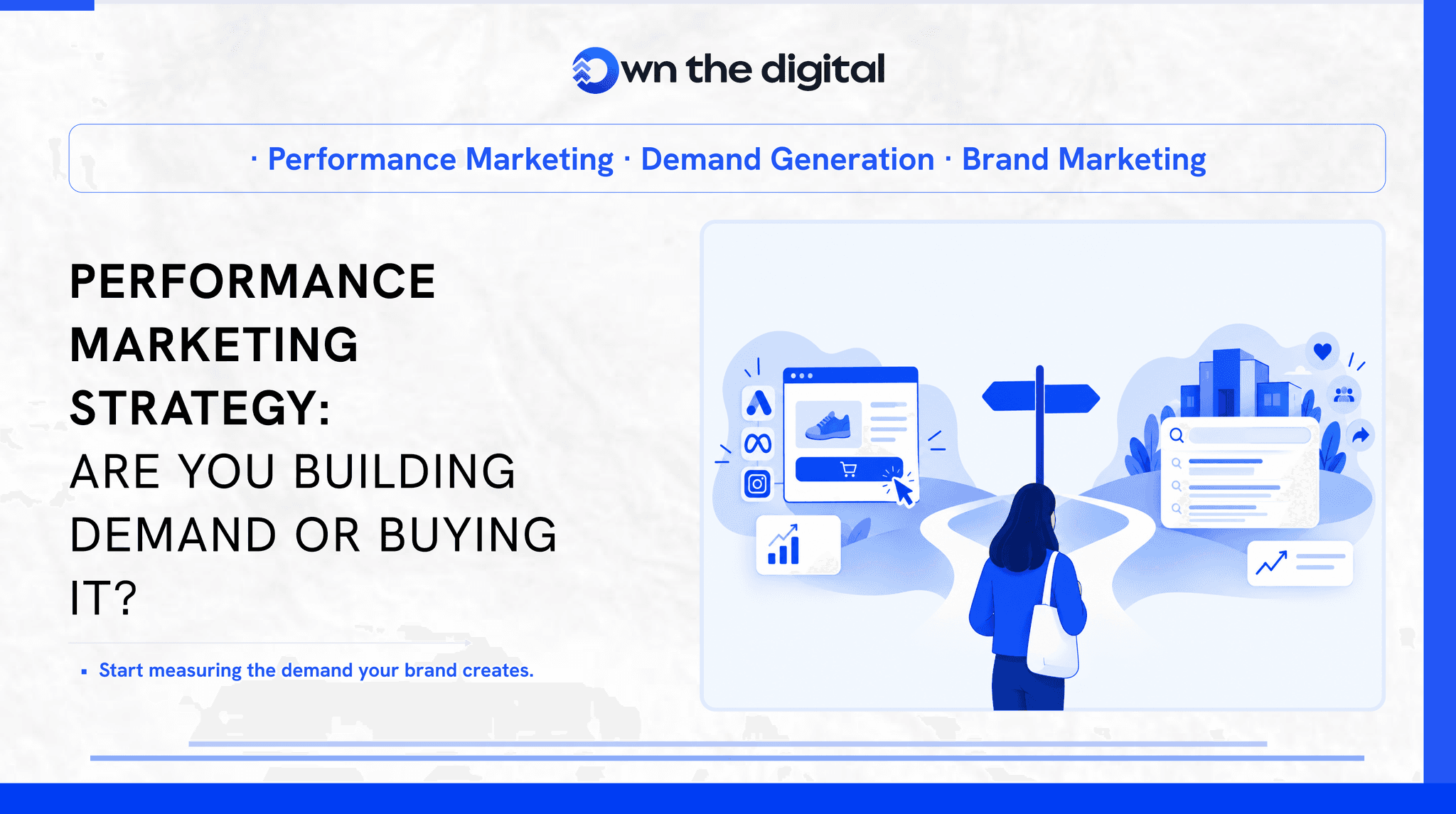
A sustainable performance marketing strategy should capture demand while helping create stronger brand demand over time.
Conceptual image representing a performance marketing strategy that balances paid advertising, brand awareness and demand generation to create sustainable customer growth.
A strong performance marketing strategy should do more than generate immediate conversions. Discover how paid media, brand awareness and branded search can work together to build sustainable demand.
Imagine turning off your paid campaigns tomorrow. No Google Ads, no Meta campaigns, no retargeting and no carefully optimised bidding strategies running in the background. What happens to your sales? For many businesses, the immediate answer would be a noticeable drop. That does not necessarily mean your performance marketing strategy is failing. Paid advertising is designed to bring customers into your business, and it can be an extremely effective way to generate measurable results. The more important question is what your marketing is building beyond those immediate conversions.
Are you creating a brand that people remember and actively search for, or are you continuously paying to put your business in front of people who may not have been looking for you in the first place? This distinction is becoming increasingly important as businesses invest more heavily in paid acquisition. A campaign can generate clicks, leads and purchases every month while the underlying demand for the brand remains unchanged. You may be acquiring customers successfully, but if every new customer still needs to be reached through an advertisement, your growth remains heavily dependent on continuously buying attention.
A sustainable performance marketing strategy should therefore look beyond the next conversion. It should also consider whether your marketing is creating enough familiarity and demand for customers to eventually find you on their own. The objective is not to stop paid advertising, but to make sure paid media works alongside brand-building and demand-generation activities.
Performance Marketing Can Capture Demand Without Creating It
Performance marketing is particularly effective when there is already some level of customer intent to capture. Someone searches for a product or service, compares different options, clicks an advertisement, visits a website and eventually makes a purchase. Your campaign helps your business appear at an important point in that customer journey.
But what happens when the customer is not searching yet? This is where the difference between capturing demand and creating demand becomes important. Paid advertising can put your product or service in front of thousands of potential customers, but exposure alone does not guarantee that your brand will be remembered. If people see your advertisement, click through and buy, your campaign has done its job. However, if they forget the brand as soon as the transaction is over, you may have generated a sale without strengthening future demand.
There is nothing inherently wrong with this model. Performance marketing can be one of the most measurable and effective ways to acquire customers. The problem appears when paid acquisition becomes the only mechanism through which customers discover your business. When that happens, growth can become directly tied to your ability to keep purchasing attention.
That is why the conversation around performance marketing vs. brand marketing should not be about choosing one over the other. The two approaches serve different purposes. Performance marketing can capture existing intent, while brand marketing can help build familiarity and influence future demand. A strong marketing strategy needs to understand how both contribute to the overall customer journey.
Branded Search Is a Useful Demand Signal
One valuable signal within your Google Ads and search data is branded search. Branded search refers to people searching specifically for your company, product or brand rather than searching only for a generic category, problem or solution.
For example, there is a meaningful difference between someone searching for “performance marketing agency” and someone searching for a specific agency by name. The first search can indicate category-level intent, while the second suggests that the person already knows about a particular brand and wants to investigate it.
Of course, not every branded search can be attributed to a specific awareness campaign. People discover brands through recommendations, social media, organic search, previous experiences, PR, content, offline conversations and many other channels. However, the overall trend in branded search can still provide useful context.
Instead of looking only at how many branded keywords you are bidding on, look at whether the number of people searching for your brand is changing over time. If paid acquisition is increasing month after month but branded searches remain completely flat, it is worth asking a broader marketing question: are you creating demand, or are you simply buying it?
A Remembered Brand Can Change How Customers Find You
Brand awareness is sometimes treated as an abstract marketing concept because its impact does not always appear neatly inside a last-click attribution report. However, being remembered has practical value. A customer who remembers your business does not necessarily need to encounter another generic advertisement before taking the next step. They may search for your company directly, visit your website, follow your social channels, engage with your content or return when they are ready to buy.
This is where brand awareness marketing and performance marketing can start working together. A customer might first encounter your brand through a video campaign without clicking. A week later, they may see another piece of content. Later, they could search for your brand and eventually convert through organic search or paid search.
If you judge every interaction only by the final click, much of that journey disappears from your analysis. The objective is not to claim that every branded search or conversion was caused by an awareness campaign. Instead, the goal is to understand whether your broader marketing activity is contributing to stronger demand and greater familiarity with the brand over time.
Do Not Judge Your Marketing Only by CPA
CPA matters. ROAS matters. Conversions and revenue matter. These are essential metrics for understanding how efficiently your campaigns are generating measurable business outcomes. However, they do not necessarily answer another important question: is demand for the brand itself increasing?
This is why branded search and direct traffic can be useful alongside traditional performance metrics. Imagine a business increases its investment in video, social content and reach-focused campaigns. The immediate return may not look as impressive as a tightly optimised search campaign. Several months later, however, branded searches have increased, direct traffic has grown and paid campaigns continue to generate conversions at improving efficiency.
Looking at these signals together provides more context than looking at the original campaign's ROAS alone. It may indicate that the business is building greater familiarity while continuing to capture existing demand through paid channels.
That does not mean awareness activity automatically caused every positive change. Seasonality, promotions, PR, organic content, market conditions and other factors can influence marketing performance. However, when multiple indicators move in the same direction over a meaningful period, they can help you understand whether your broader marketing investment is contributing value beyond immediate paid conversions.
Give Demand Generation Enough Time to Develop
One of the biggest challenges with a demand generation strategy is that its impact does not always appear immediately. A conversion campaign can tell you what happened today, while demand generation may influence a customer who searches for your company several weeks later, returns to your website the following month and eventually converts through another channel.
Trying to judge every marketing activity through the same last-click ROAS framework can therefore create an incomplete picture. This does not mean awareness campaigns should receive unlimited budgets without accountability. Every marketing investment still needs a clear purpose and measurement framework. The difference is that the measurement should reflect the job the campaign is designed to perform.
For example, a business could consider allocating a portion of its marketing budget to reach and video activity that is not judged exclusively by immediate last-click ROAS. The appropriate percentage will depend on the business, customer journey, category, existing brand awareness and available budget. The important point is to give the activity enough time to generate meaningful data rather than making a decision after only a few days.
After a meaningful testing period, compare changes in branded search, direct traffic and paid acquisition efficiency. If these signals are moving together, you have a stronger basis for understanding whether your broader marketing investment is contributing to demand.
Build a Demand Scoreboard
Your marketing dashboard does not need to become unnecessarily complicated. Start with a small set of signals that tell different parts of the story. Branded search can help you understand whether more people are actively searching for your company, product or brand. Rather than focusing on a single month, monitor the trend over a longer period because search behaviour can fluctuate for many reasons.
Direct traffic can provide another useful signal. If more people are arriving at your website directly, it may indicate greater familiarity with the brand, although direct traffic is also affected by tracking and attribution limitations. It should therefore not be treated as a standalone measurement of brand awareness.
Finally, continue monitoring paid acquisition efficiency. What is happening to CPA, ROAS, conversion volume and revenue? If paid campaigns are becoming more efficient while branded search and direct traffic are also increasing, the combination is worth investigating.
None of these metrics should be treated as standalone proof of brand growth. Together, however, they can create a more complete picture of whether your paid advertising strategy is simply generating transactions or contributing to a broader demand engine.
The Goal Is Not to Stop Running Ads
The answer to paid advertising dependency is not to switch off your campaigns and wait for customers to arrive organically. For many businesses, paid advertising will remain an essential part of customer acquisition. Google Search can capture high-intent demand, social advertising can introduce products to new audiences and retargeting can reconnect with people who have already shown interest.
The bigger goal is to avoid making paid advertising responsible for everything. Your performance campaigns should capture people who are ready to act, while your brand activity should help more people become familiar with your business before they are ready to act.
Over time, that familiarity can contribute to branded searches, direct visits, organic engagement, recommendations and returning customers. This is where the relationship between brand and performance becomes particularly valuable. You are still using paid media to acquire customers, but your brand is gradually doing more of the work alongside it.
So, What Happens If You Turn Off Your Ads?
The question is not simply whether sales would decline if you switched off every advertisement tomorrow. For a business that relies heavily on paid acquisition, they probably would. The more useful question is how dependent your business is on paid media for customers to discover, remember and return to your brand.
If branded search is growing, direct traffic is increasing and paid acquisition is becoming more efficient, you may be seeing signs that your marketing is building something beyond immediate conversions. If those signals remain stagnant while advertising spend continues to increase, it may be worth examining whether your strategy is too heavily focused on capturing existing demand.
Final Thoughts: Build Demand, Not Just Campaigns
A strong performance marketing strategy should not be measured only by how many clicks, leads or sales it generates today. Those metrics are important, but sustainable marketing also requires businesses to consider what happens between transactions and what customers remember when they are ready to buy again.
Paid advertising is powerful because it can capture existing demand and deliver measurable results. Brand building and demand generation serve a different purpose by helping more potential customers become familiar with your business before they actively search for a solution. When these approaches work together, paid media does not have to carry the entire responsibility for customer acquisition.
The real opportunity is to build a marketing ecosystem in which advertising captures demand while brand activity helps create more of it. Over time, that can mean more people searching for your brand, more customers returning directly to your website and potentially greater efficiency across your paid campaigns.
At Own The Digital, we look beyond individual campaign metrics to understand how paid media, brand activity and customer behaviour work together. If you want to understand whether your marketing is simply generating conversions or actually building long-term demand for your business, the next step is to look beyond the ad dashboard and examine the bigger picture.
Your ads can generate sales today. Your broader marketing strategy should help make sure you do not have to pay for every customer tomorrow.