Retail Media Advertising: How Retailers Are Changing Ads
Retail media connects digital advertising with real shopping behaviour, helping brands reach customers closer to the point of purchase.
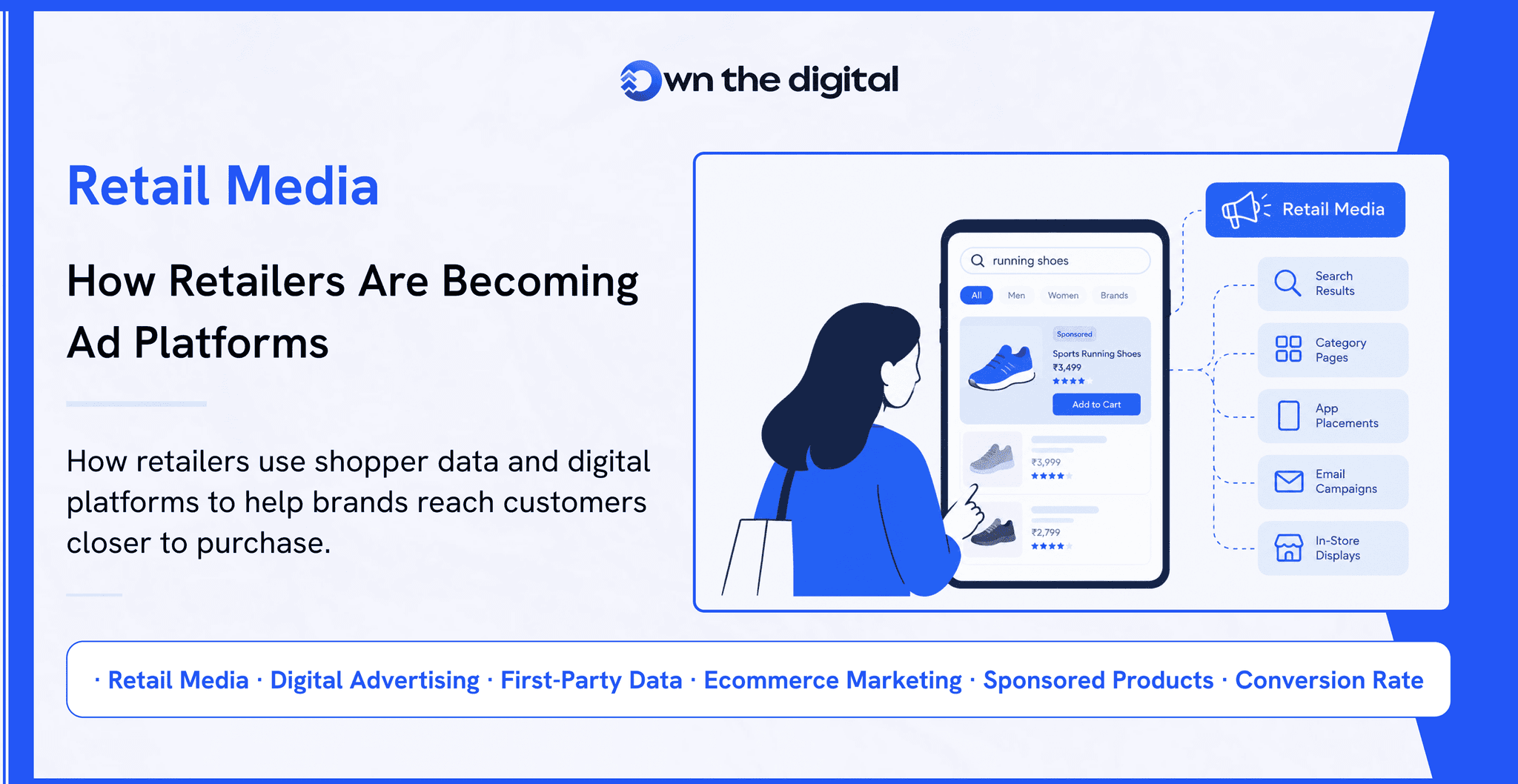
An illustration of retail media advertising showing how ecommerce platforms use sponsored product placements and digital advertising to connect brands with shoppers during the buying journey.
Retailers are becoming powerful advertising platforms. Discover how retail media advertising uses first-party data, shopping intent, and sponsored placements to connect brands with customers and drive measurable growth.
What Is Retail Media?
Advertising used to be built around a relatively simple exchange. Brands paid publishers, television networks, search engines or social platforms to place their message in front of an audience. The retailer’s role usually came later, when the customer was ready to buy. Retail media is changing that separation. Today, retailers are increasingly becoming advertising platforms themselves, allowing brands to reach shoppers using the retailer’s own digital properties, customer data and purchasing environment.
A customer searching for a product on an ecommerce marketplace, browsing a retailer’s website or using its app may now encounter sponsored products, promoted listings, display placements or personalised recommendations before completing a purchase. This creates an advertising environment where the distance between an ad impression and a transaction can be much shorter than it is on many traditional media channels.
Retail media advertising refers to advertising opportunities created and sold by retailers using their digital platforms, physical stores, customer relationships and first-party data. Ecommerce websites, marketplaces, grocery chains, pharmacies and other retailers can provide brands with advertising placements that reach consumers while they are already researching or shopping for products.
These placements can appear across search results, category pages, product pages, homepages, apps, email communication and, in some cases, physical stores through screens or other digital formats. The defining characteristic is not simply that a retailer is displaying an advertisement. It is that the retailer has valuable information about shopping behaviour and can use that environment to connect advertising with commercial activity.
This creates an important difference from many conventional advertising channels. A social platform may know that a person is interested in fitness because of their online behaviour, while a retailer may know that the same person has recently purchased running shoes, regularly searches for sports equipment and frequently shops within a particular product category. The retailer’s data is closely connected to actual shopping activity.
For advertisers, that can make the environment particularly valuable because advertising can take place closer to the point where purchase decisions are being made.
Why Has Retail Media Become So Important?
One of the biggest reasons behind the growth of retail media is the increasing value of first-party data. Changes in privacy expectations, tracking limitations and the broader evolution of digital advertising have made customer data more complicated to collect and use across platforms.
Retailers, however, have a direct relationship with people who shop through their websites, apps and stores. They can observe searches, product views, purchases and other interactions that occur within their own ecosystem. This gives retailers an asset that advertisers increasingly want: information connected to actual shopping behaviour.
Retailers have also realised that their digital properties are not just places where transactions happen. They have become high-intent environments where consumers actively search for products, compare alternatives and decide what to purchase.
A person browsing a social media platform may be casually consuming content when an advertisement appears. Someone searching for a particular product on a retailer’s website is operating with a very different level of intent. They may already be considering a purchase.
Advertising at this stage can therefore have a fundamentally different role because the brand is not necessarily trying to create demand from scratch. It may be trying to influence which product the shopper chooses.
Retail Media Is Not Just Sponsored Products
Sponsored product listings are one of the most recognisable forms of retail media, but the category extends well beyond search results. Retailers can offer advertising opportunities across multiple parts of the customer journey.
Brands may be able to promote products within search results, appear on category pages, display banners across ecommerce properties, use video placements, promote products through apps or participate in retailer-owned email and loyalty programmes. Physical stores can also become part of the retail media ecosystem through digital screens, in-store displays and other advertising formats.
This variety allows retailers to create advertising packages that combine different touchpoints. A brand might first reach a shopper through an awareness placement and later appear when that shopper searches for a relevant product. Another campaign may focus almost entirely on shoppers who are already comparing products in a particular category.
The strategy can therefore move beyond simply buying a banner and toward influencing the customer journey within an environment where the retailer already understands shopping behaviour.
The Biggest Advantage Is Proximity to Purchase
The strongest argument for retail media is the proximity between advertising and purchasing behaviour. Consider the difference between seeing an advertisement while scrolling through a social platform and seeing a sponsored product while actively searching for something to buy. Both impressions have value, but the intent behind them can be very different.
A shopper searching for “running shoes” is already engaged with a product category. If a relevant brand appears prominently in those results, the advertisement can influence a decision that may already be forming.
The brand does not necessarily need to convince the person that running shoes exist or explain why they might need them. The customer has already crossed much of that distance. The advertiser’s job becomes making the product visible, relevant and compelling enough to be considered.
This is one reason retail media can be particularly attractive for consumer brands. The advertising opportunity exists close to an actual commercial event, which can make it easier to connect media exposure with sales.
Retail Media and First-Party Data
Data is one of the most valuable components of a retail media business. Retailers can potentially understand what customers search for, what categories they browse, what products they purchase and how often they return. Depending on the retailer and the permissions involved, this information can help advertisers reach audiences based on actual shopping behaviour rather than broad demographic assumptions.
This creates a different type of targeting opportunity. Instead of simply identifying people who are likely to be interested in a category, advertisers can potentially reach people based on demonstrated behaviour within a retail ecosystem.
Someone who repeatedly researches a particular category may represent a different opportunity from someone who has never interacted with it. A previous purchaser can also be approached differently from a first-time shopper.
The value of this data comes from its connection to commerce. It does not merely describe what someone might be interested in. It can provide signals about what they actually do as shoppers.
Retail Media Can Influence Both Discovery and Conversion
Retail media is often associated with customers who are already close to purchasing, but its role can extend further up the funnel. Retailers have large audiences and significant consumer attention, which gives them opportunities to introduce new products and brands before a shopper reaches the final decision stage.
Display advertising, sponsored content, video and other placements can help build awareness within a retail environment.
The important difference is that the same ecosystem can potentially support the customer later when they move closer to purchase. A shopper might first encounter a new brand through a display placement, later search for the product on the retailer’s platform and eventually purchase it.
That creates an opportunity for advertisers to think about retail media as more than a collection of conversion placements. For brands, this can make the retailer a media partner throughout different stages of the buying journey rather than simply a distribution channel.
Measuring Retail Media Requires More Than Counting Clicks
Retail media can provide strong visibility into advertising performance, but advertisers still need to be careful about which metrics they prioritise. Click-through rate, cost per click and impressions can help evaluate campaign delivery, but they do not necessarily capture the complete value of retail advertising.
Because retail media operates close to transactions, advertisers can often focus more heavily on commercial outcomes. Sales, conversion rate, return on ad spend, new customer acquisition, repeat purchases and incremental revenue can provide more useful information about whether a campaign is actually contributing to growth.
The exact measurements will depend on the retailer, campaign objective and level of data available.
Incrementality is particularly important. If a customer was already going to purchase a product without seeing the advertisement, attributing the entire transaction to the campaign can make performance look stronger than it actually was.
Advertisers therefore need to distinguish between sales that were merely attributed to advertising and sales that were genuinely influenced by it.
Retail Media Creates a New Relationship Between Retailers and Brands
Retail media changes the relationship between retailers and the brands they sell. Traditionally, retailers primarily earned money from product sales and related commercial arrangements. Advertising creates another potential revenue stream from the same customer ecosystem.
The retailer can monetise its digital traffic and customer data while brands gain access to an environment where people are actively shopping.
This creates incentives for retailers to develop sophisticated advertising infrastructure. Search placements, audience segmentation, measurement systems, sponsored listings and other advertising products can become meaningful parts of a retailer’s business model.
As these capabilities develop, retailers increasingly begin to resemble media companies as well as commerce businesses.
For brands, that means the retailer relationship may involve more than negotiating shelf space or distribution. Advertising strategy can become another part of the partnership.
The Growth of Retail Media Also Creates New Challenges
The expansion of retail media does not mean every retail advertising opportunity is automatically valuable. As more retailers build advertising products, advertisers can end up managing campaigns across multiple networks, each with different reporting systems, audience definitions and measurement approaches.
Fragmentation can make it difficult to compare performance consistently.
There is also the question of transparency. Advertisers need to understand where their ads are appearing, what audiences they are reaching and how reported conversions are being attributed. If a retailer controls both the advertising environment and the sales data, it becomes particularly important to understand how performance is calculated.
Another challenge is competition within the retail environment. When multiple brands compete for sponsored placements, advertising can become expensive, especially for categories where product margins are already tight.
Brands need to consider not only whether an advertisement generates sales but whether the economics of those sales justify the media cost.
Retail Media Is Changing the Meaning of “Where Customers Are”
For years, digital marketers have talked about reaching customers where they spend their time. Social networks, search engines, websites and video platforms have dominated much of that conversation.
Retail media adds another important environment: the places where people are actively shopping.
This distinction matters because the same person can have completely different intent depending on where they are. Someone watching a video may be discovering a category. Someone searching Google may be researching options. Someone browsing a retailer’s product page may already be comparing products. Someone returning to a shopping app may already have a strong purchase intention.
Retail media allows brands to participate in that final environment and potentially influence the decision while it is happening.
How Brands Should Approach Retail Media
Brands entering retail media should avoid treating it as another advertising channel that can simply be added to an existing media plan without modification. The strategy needs to account for the environment in which the advertising is taking place.
Product availability, pricing, reviews, product descriptions, imagery and inventory can all influence what happens after an advertisement is clicked or viewed.
A strong advertising campaign cannot compensate indefinitely for a weak product listing. If the advertised product has poor images, unclear information, weak reviews or an uncompetitive price, driving more shoppers toward it may simply increase the number of people who decide not to buy.
Retail media therefore connects advertising more closely with merchandising and ecommerce execution. The advertising team, ecommerce team and product team may need to work together rather than treating media buying as a completely separate function.
Retail Media and the Future of Performance Marketing
Retail media sits at an interesting point between advertising, ecommerce and data. It gives brands access to audiences within environments where shopping behaviour is already taking place, while giving retailers a new way to monetise their digital properties and customer relationships.
As more businesses develop retail media networks, advertisers will have more opportunities to reach consumers based on shopping context and intent.
However, growth in retail media will also make strategy more important. Simply appearing on a retailer’s platform will not guarantee profitable growth. Brands will need to understand which audiences they are buying, what part of the customer journey they are influencing, how much incremental value the advertising creates and whether the economics make sense after media costs.
The strongest advertisers will likely be the ones that connect retail media data with the broader picture rather than evaluating each campaign as an isolated advertising activity.
Final Takeaway
Retail media is changing the role retailers play in digital advertising. They are no longer only the place where a customer completes a transaction. Their websites, apps, stores, search systems, loyalty programmes and customer data can all become part of an advertising ecosystem.
For brands, that creates an opportunity to reach consumers much closer to the moment of purchase and use shopping behaviour to make advertising more relevant. But the opportunity comes with a responsibility to look beyond impressions and clicks.
The real question is whether the advertising is influencing valuable customer behaviour and creating incremental business growth.
As the line between commerce and media continues to become less distinct, retail media is likely to become an increasingly important part of the performance marketing mix. The brands that benefit most will not necessarily be the ones that spend the most. They will be the ones that understand where advertising fits into the shopping journey, what the data actually means and whether the resulting sales are genuinely worth paying for.
Ready to Make Your Advertising Work Smarter?
Reaching the right audience is only part of the equation. What matters is turning that attention into meaningful business growth. From understanding customer behaviour to building data-driven campaigns, the right advertising strategy can help your business make every marketing investment count.
At Own The Digital, we help businesses make smarter marketing decisions through performance-focused strategies built around their goals. Whether you're exploring new advertising opportunities or looking to improve your existing campaigns, we're here to help you move from clicks to measurable results.
Ready to get more out of your marketing? Explore Own The Digital and discover how the right strategy can help your business grow.