WhatsApp Marketing: Turn Conversations Into Conversions
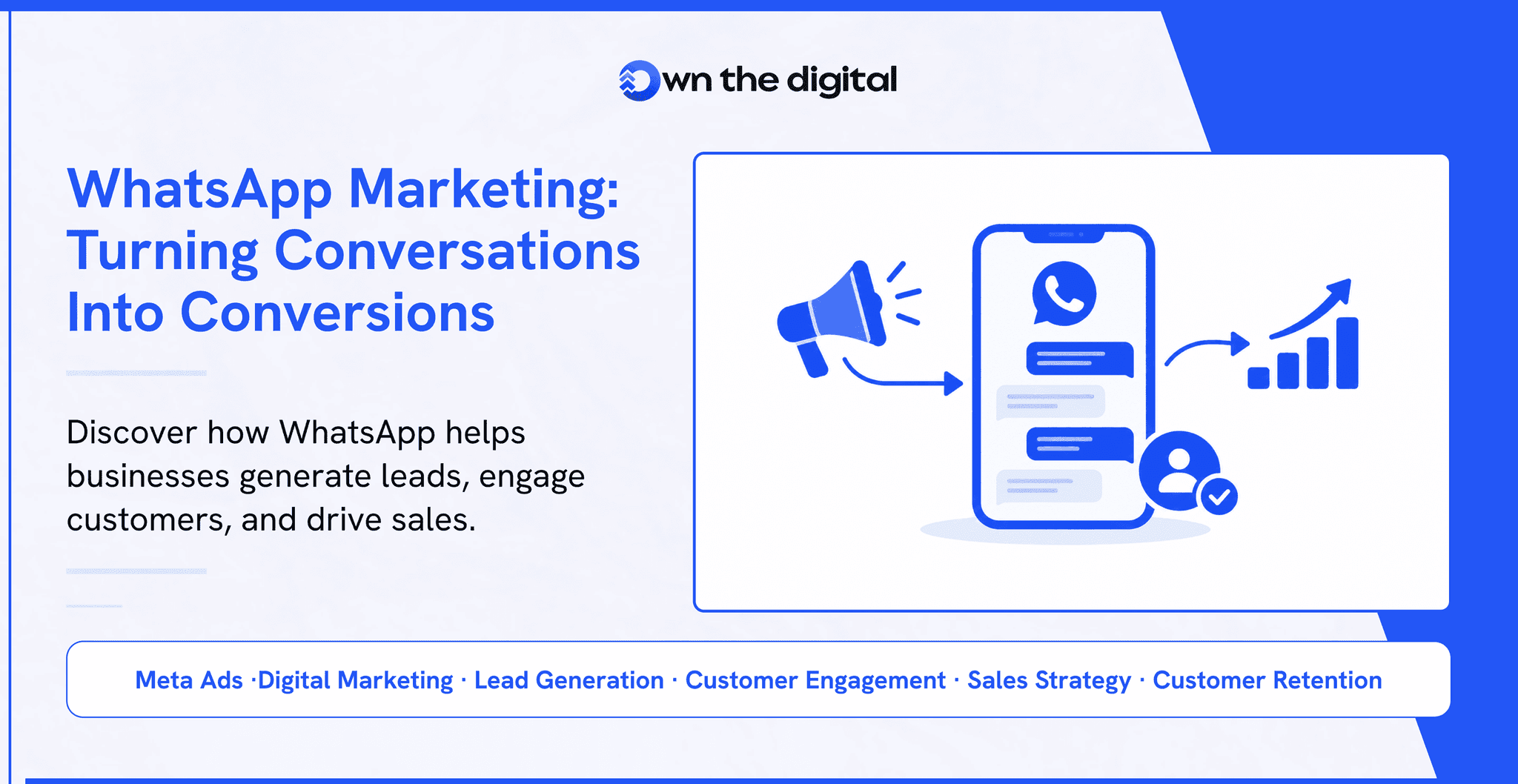
WhatsApp marketing helps businesses turn customer conversations into meaningful opportunities and conversions.
A business professional communicating with customers through WhatsApp to support lead generation, customer engagement, and conversions.
Discover how businesses can use WhatsApp marketing for lead generation, personalised follow-ups, automation, customer engagement, and measurable conversions.
WhatsApp has become much more than a platform for sending personal messages. For businesses, it has developed into a direct communication channel where potential customers can ask questions, compare options, enquire about products, book appointments, receive updates and continue conversations with a brand.
This makes WhatsApp marketing different from many traditional digital marketing channels. An advertisement may create awareness or bring someone to a website, but a WhatsApp conversation can take place much closer to the point where a customer is making a decision. Instead of asking every prospect to move through multiple pages, forms and emails, businesses can create a more direct path between interest and interaction.
However, simply sending promotional messages to a database does not qualify as an effective WhatsApp marketing strategy. The value of the channel comes from using it thoughtfully, understanding where it fits into the customer journey and giving people a genuine reason to continue the conversation.
What Is WhatsApp Marketing?
WhatsApp marketing refers to the use of WhatsApp as part of a business’s marketing and customer communication strategy. Depending on the type of business, it can be used for lead generation, product enquiries, promotions, customer support, appointment scheduling, order updates, follow-ups and retention.
A service business may use WhatsApp to communicate with prospects who want pricing or a consultation, while an ecommerce company may use it to answer product questions, recommend products or follow up with customers who have shown purchase intent.
The important distinction is that WhatsApp can support several stages of the customer journey rather than functioning only as a promotional channel. When it is integrated properly with advertising, sales and customer service, the conversation can continue from the point where a person first shows interest instead of forcing them to start the process again on another platform.
Why Is WhatsApp Marketing Important for Businesses?
The biggest advantage of WhatsApp marketing is the direct nature of the communication. A person who contacts a business on WhatsApp is no longer simply part of a broad audience that may or may not be interested in an advertisement. They have taken an additional step by starting or continuing a conversation.
This creates an opportunity for the business to understand what the customer needs and respond accordingly. That can be particularly valuable for products and services where customers have questions before making a decision.
Someone looking for a software development service, for example, may want to discuss their requirements before requesting a quotation. A customer buying an expensive product may want to confirm specifications, delivery information or availability. In these situations, a conversation can remove uncertainty faster than a generic landing page.
WhatsApp does not eliminate the need for websites, search or paid advertising, but it can provide another route for customers who prefer direct communication.
WhatsApp Marketing Is Not the Same as Sending Bulk Messages
One of the most common mistakes businesses make with WhatsApp marketing is treating it like a simple broadcast list. A business collects phone numbers, creates a promotional message and sends the same communication to everyone. While this may create short-term reach, it does little to create meaningful customer relationships.
People who have different interests, purchase histories and levels of intent should not necessarily receive identical messages. Someone who has just discovered a brand needs a different type of communication from someone who has already purchased from it.
Similarly, a person who has asked about a product may respond differently to a useful follow-up than someone who has never interacted with the business. Effective WhatsApp marketing depends on relevance. The more closely a message reflects the customer’s previous interaction and current needs, the more useful the communication becomes.
How WhatsApp Can Support Lead Generation
WhatsApp can be particularly useful for businesses that depend on enquiries before a sale takes place. Traditional lead generation often involves sending a user from an advertisement to a landing page where they are asked to complete a form. That process can work well, but it also introduces several points where the prospect can leave.
They may not want to fill out a lengthy form, may have a question that the page does not answer or may simply want to speak with someone before sharing their details. A WhatsApp conversation can reduce some of this friction by allowing the person to communicate directly with the business.
For example, an advertisement for a marketing agency could encourage a potential client to start a conversation about their current advertising challenges. The business can then understand their requirements, answer initial questions and determine whether the prospect is a suitable lead.
This does not mean every WhatsApp conversation will become a customer, but it can make the early part of the sales process more interactive.
WhatsApp and Paid Advertising Can Work Together
WhatsApp marketing becomes even more useful when it is connected to paid advertising rather than operated as a completely separate activity. Businesses can use advertising to reach relevant audiences and encourage them to initiate a WhatsApp conversation. This creates a connection between paid media and direct communication.
Instead of measuring the campaign only by impressions, clicks or even the number of conversations started, the business can evaluate what happens after people enter the conversation.
Are they asking genuine questions? Are they qualified prospects? Are appointments being booked? Are purchases taking place?
These questions are important because a campaign can generate a large number of WhatsApp conversations without producing meaningful commercial results. The objective should therefore be to attract the right conversations rather than simply increase the number of messages received.
The First Conversation Can Influence Conversion
Once a potential customer starts a WhatsApp conversation, the quality of the interaction becomes part of the marketing experience. A customer who receives an irrelevant automated message or waits too long for a response may lose interest even if the original advertisement was effective.
On the other hand, a useful and timely response can move the customer closer to a decision. Businesses should therefore think about what happens immediately after someone contacts them.
The first response should make it easy for the customer to explain what they need instead of creating unnecessary friction. Depending on the business, this could involve providing clear options, asking a relevant question or directing the person to the appropriate member of the team.
The purpose is not to make every conversation completely automated. It is to create a communication process where customers can quickly reach the information or assistance they actually need.
Personalisation Makes WhatsApp Communication More Relevant
The conversational nature of WhatsApp also creates opportunities for better personalisation. However, personalisation should mean more than simply adding the customer’s name to a message. Useful personalisation comes from understanding the context of the interaction.
A customer who recently purchased a product may receive information about how to use it or relevant accessories. Someone who requested a quotation may receive a follow-up related to that enquiry. A customer who has previously booked an appointment may receive information relevant to an upcoming visit.
When the message reflects an actual customer action, it feels more relevant because there is a logical reason for the business to be contacting that person. When personalisation is added only for the sake of appearing personal, it can quickly become repetitive and ineffective.
WhatsApp Can Help Businesses Follow Up With Interested Customers
A large percentage of potential customers do not convert during their first interaction with a business. They may need more information, may be comparing alternatives or may simply not be ready to make a decision immediately.
WhatsApp can provide a convenient channel for following up with people who have already shown interest. However, the quality of the follow-up matters. Sending repeated messages asking whether someone is ready to buy does not create much value.
A stronger follow-up gives the customer something relevant to consider, such as additional information, an answer to a previous question, clarification about the service or an update related to their enquiry. The objective should be to keep the conversation useful rather than simply reminding the customer that the business wants a sale.
Automation Can Make WhatsApp Marketing More Scalable
Businesses handling a large number of conversations cannot always rely entirely on manual communication. Automation can help manage repetitive parts of the customer journey, including confirmations, reminders, frequently asked questions, order updates and basic lead routing.
This can reduce the amount of repetitive work handled by sales and support teams while ensuring that customers receive important information quickly.
However, automation should have a clear purpose. If a customer has a complex question and is forced through several automated responses without an option to speak to a person, the experience can become frustrating.
The most practical approach is often to automate predictable interactions while allowing conversations to move to a human team member when the situation requires judgement, clarification or a more personalised response.
How Should Businesses Measure WhatsApp Marketing?
The number of messages sent is not enough to determine whether a WhatsApp marketing campaign is successful. Even the number of conversations started can be misleading because not every conversation represents genuine purchase intent.
Businesses should connect WhatsApp activity with the outcomes that matter to their particular model. A lead-generation company may look at qualified conversations, appointments and eventual sales, while an ecommerce business may focus on purchases and revenue generated through WhatsApp interactions.
Useful performance metrics include:
- Response rate
- Qualified lead rate
- Conversion rate
- Cost per qualified conversation
- Customer acquisition cost
- Revenue generated
These metrics can provide a much better understanding of performance than message volume alone. This is especially important when WhatsApp is being used alongside Meta Ads or other paid campaigns because the advertising dashboard may show that a campaign generated conversations without showing the complete commercial outcome.
WhatsApp Marketing Should Be Part of a Larger Customer Journey
WhatsApp should not exist in isolation from the rest of a company’s marketing strategy. A potential customer might first discover a business through Google, see a social media post, click a Meta advertisement, visit the website and eventually start a WhatsApp conversation.
Another customer might begin with a WhatsApp enquiry after seeing a recommendation from someone they know. Different channels can therefore play different roles in the same customer journey.
The purpose of WhatsApp is not to replace every other channel but to provide a useful communication layer where direct interaction can improve the experience. Businesses should identify the points in their customer journey where people commonly have questions, hesitate before converting or need assistance and then determine whether WhatsApp can make those points easier to navigate.
Avoid Turning WhatsApp Into Another Spam Channel
The direct nature of WhatsApp is also the reason businesses need to be careful with how they use it. Customers are more likely to ignore a promotional email than a message appearing directly in a messaging application they use every day.
Excessive promotional messages, irrelevant offers and communication without appropriate permission can quickly damage trust. Businesses should therefore be thoughtful about who they contact, why they are contacting them and how frequently they communicate.
Marketing messages should follow applicable consent and messaging requirements, while customers should have appropriate ways to manage or stop unwanted communications. The goal should be to make each interaction useful enough that customers recognise the reason for hearing from the brand rather than feeling that their inbox has simply become another advertising space.
WhatsApp Marketing Is About the Conversation, Not the Channel
The strongest WhatsApp strategies do not begin with the assumption that the platform itself will increase conversions. They begin with a customer problem.
Maybe prospects are not getting answers quickly enough. Maybe a complicated enquiry process is causing potential leads to disappear. Maybe customers need more assistance before buying. Maybe existing customers need better follow-up after a purchase.
Once the problem is understood, WhatsApp can be introduced where direct communication can solve it. This approach produces a much stronger strategy than simply deciding to “start WhatsApp marketing” because other businesses are using it.
The channel matters, but the experience created through the channel matters more.
Final Takeaway
WhatsApp marketing gives businesses a way to move beyond one-way advertising and create direct conversations with potential and existing customers. Its value comes from reducing unnecessary friction, answering questions, following up with relevant prospects and making it easier for customers to take the next step.
However, sending more messages does not automatically create more sales. Businesses need to focus on relevance, response quality, personalisation, appropriate automation and measurable outcomes.
The strongest WhatsApp strategy is therefore not built around how many promotional messages a business can send. It is built around how effectively the business can use conversations to help customers make decisions.
When WhatsApp is connected properly with paid advertising, sales, customer service and the wider digital journey, it can become more than another marketing channel. It can become the point where customer interest turns into an actual conversation and that conversation has the potential to turn into business.
Ready to Turn Conversations Into Conversions?
Want to generate quality leads and turn customer conversations into real business opportunities? Own The Digital helps businesses build smarter digital marketing strategies that connect the right audience with the right message.
From Meta Ads and lead generation to conversion-focused marketing, we help you move beyond clicks and focus on measurable business growth.
Ready to grow your business? Connect with Own The Digital today and let's turn your marketing efforts into meaningful results.