The CTR Trap: Why a Higher CTR Can Mislead Your Marketing
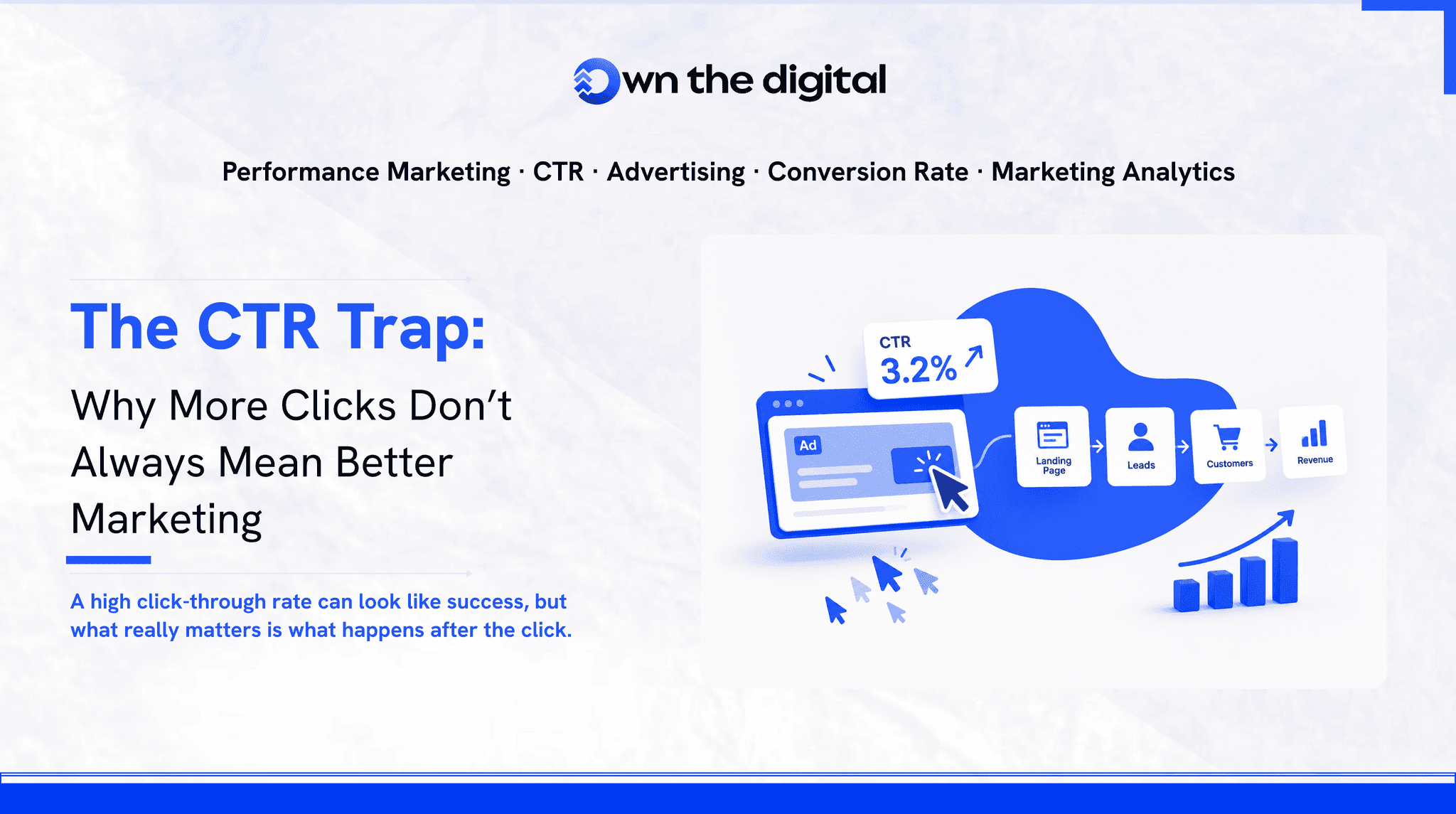
A higher click-through rate can look positive, but the real measure of marketing performance is what happens after the click.
A conceptual marketing analytics image illustrating the CTR trap, where high click-through rates may not lead to qualified leads, customers, or revenue. The visual represents the journey from ad impressions and clicks to engagement, conversions, qualified customers, and business revenue.
A high click-through rate can look like a marketing win, but clicks do not always translate into qualified leads, customers, or revenue. Learn how to look beyond CTR and measure what really matters.
A higher click-through rate usually feels like good news. More people are clicking your ad, your creative seems to be working, and the campaign dashboard is giving you a number that looks better than before. So the natural reaction is to increase the budget and assume the campaign is moving in the right direction. But there is a problem with that assumption. CTR tells you that people clicked. It does not tell you whether those clicks were valuable.
This is where the CTR trap begins. A campaign can generate an impressive click-through rate while producing fewer qualified leads, completed purchases, meaningful enquiries, or actual revenue. When marketers optimise too heavily around CTR, they can end up improving the easiest part of the funnel while overlooking everything that happens after the click. The result is a campaign that looks successful inside the advertising dashboard but struggles when measured against the business outcome that actually matters.
What Is the CTR Trap?
The CTR trap happens when marketers treat click-through rate as a direct indicator of campaign success instead of seeing it as one signal within a much larger customer journey. CTR measures the percentage of people who clicked after seeing an ad. It can tell you whether an ad attracted attention strongly enough to make someone take the next step. What it cannot tell you is whether that person had genuine intent, whether the landing page delivered on the promise of the ad, whether they became a qualified lead, or whether they eventually generated revenue.
Consider a campaign that increases its CTR from 1.5% to 3%. On paper, that looks like a clear improvement. But imagine that the new audience is clicking because the creative uses a broad or highly curiosity-driven message. Once they reach the website, most visitors leave without taking another action. The campaign has technically improved its CTR, but the business has not necessarily improved its performance.
This is why CTR should be treated as a diagnostic metric, not the final scorecard.
Why a High CTR Can Be Misleading
One of the biggest reasons CTR can become misleading is that people click for many different reasons. A strong headline, an interesting visual, a surprising claim, or a curiosity gap can all encourage someone to click. But a click does not automatically represent purchase intent.
For example, an ad that says “You’re probably wasting money on this” may generate strong curiosity. People may click simply because they want to know what they are doing wrong. That can produce an attractive CTR. But if the product being advertised is expensive, highly specialised, or relevant only to a narrow audience, those additional clicks may not translate into qualified demand.
The same issue appears when the message in the ad does not accurately reflect what happens after the click. If the advertisement makes a broad promise but the landing page introduces a completely different proposition, users may click but quickly leave. In that situation, the ad succeeded at generating attention but failed at creating a useful transition into the next stage of the funnel.
A high CTR, therefore, can sometimes hide a quality problem rather than solve a performance problem.
The Metrics You Should Look at After CTR
CTR becomes much more useful when it is analysed alongside the metrics that come after the click. Instead of asking only whether people clicked, marketers need to understand what those people did next.
Look at landing page engagement, conversion rate, cost per qualified lead, lead-to-customer rate, purchase rate, average order value, and ultimately revenue or return on ad spend where appropriate. The exact metrics will depend on the business model, but the principle remains the same: connect the click to the business outcome.
Suppose Campaign A has a 2% CTR and generates 100 leads, but only five of them are qualified. Campaign B has a 1.2% CTR and generates 60 leads, but 20 of those leads are genuinely interested prospects. Looking only at CTR would make Campaign A appear stronger. Looking at lead quality changes the conversation entirely.
This does not mean Campaign B automatically wins in every situation. Cost, conversion rates, sales cycle, customer value, and revenue still matter. The point is that CTR alone cannot answer the question.
A Better Way to Read Your Advertising Funnel
Instead of viewing CTR as an isolated number, look at the journey from impression to revenue.
The first question is whether the ad earns attention. CTR can help answer that. The next question is whether the click represents meaningful intent. Landing page behaviour and downstream conversion data can provide more context. Then comes the quality of the conversion. A lead that submits a form but has no buying intent should not carry the same weight as a sales-ready prospect. Finally, the business needs to understand whether those conversions actually create revenue.
Impression → Click → Engagement → Conversion → Qualified Conversion → Customer → Revenue
Every stage tells you something different. A problem at one stage cannot necessarily be solved by improving the metric at another stage.
If CTR is rising but qualified conversions are falling, the answer may not be to celebrate the creative. It may be to investigate who is clicking, what promise attracted them, whether the landing page matches that promise, and whether the campaign is reaching the right audience.
When Improving CTR Can Actually Make Performance Worse
There is another uncomfortable side to the CTR trap: optimising aggressively for clicks can sometimes encourage behaviour that moves the campaign away from business value.
If a platform or campaign strategy is heavily optimised around generating clicks, the system has an incentive to find people who are likely to click. But people who frequently click advertisements are not necessarily the same people who are most likely to purchase your product or become high-quality leads.
This distinction becomes particularly important for businesses with high-ticket products, B2B services, complex software, or longer sales cycles. The person who clicks an ad is only entering the funnel. They still need to understand the product, trust the company, meet the relevant requirements, and eventually take an action that creates business value.
For these businesses, chasing a higher CTR without understanding downstream behaviour can create a misleading sense of progress. Traffic increases, dashboards look healthier, and the marketing team has more activity to report, while sales may still be asking where the qualified opportunities are.
Your Ad and Landing Page Need to Tell the Same Story
A strong CTR is not inherently a problem. The problem begins when the reason people clicked is disconnected from what the business actually wants them to do.
Your advertisement creates an expectation. Your landing page needs to fulfil it.
If your ad promises a specific solution, the landing page should immediately reinforce that solution. If your creative speaks to a particular problem, the next page should continue addressing that problem rather than forcing the visitor to figure out why they landed there. When the message is consistent, the click has a better chance of becoming meaningful engagement.
This is why a campaign with a slightly lower CTR can sometimes perform better. The people clicking may have a clearer understanding of what they are clicking into. The traffic may be smaller, but the intent can be stronger.
The objective is not to eliminate unnecessary clicks. It is to make the right people want to click for the right reason.
CTR Should Help You Diagnose Creative, Not Define Success
CTR is still an important metric. It can reveal whether a creative is getting attention, whether a message is resonating with an audience, and whether one variation is generating more interaction than another. Ignoring it would be just as unhelpful as overvaluing it.
The key is knowing what question the metric can answer.
CTR can help you understand whether people are responding to the advertisement. It cannot tell you whether the campaign is profitable. Conversion rate can tell you how many visitors take a desired action. It cannot necessarily tell you whether those conversions are high quality. Cost per lead can tell you how efficiently leads are being generated. It does not automatically tell you how many of those leads become customers.
Every metric has a job. Problems arise when one metric is asked to answer questions it was never designed to answer.
Stop Asking “How Many People Clicked?”
The more useful question is what happened after they clicked.
Did they stay on the page? Did they understand the offer? Did they complete the intended action? Were the resulting leads relevant? Did sales consider them qualified? Did those customers generate revenue? If the answer becomes weaker at any point in that journey, increasing CTR alone will not fix the problem.
Marketing performance is not a competition to produce the highest number on an advertising dashboard. A campaign exists to move people toward a meaningful business outcome.
So the next time your CTR jumps, celebrate the signal, but do not stop there. Investigate what that additional attention actually produced.
Because more clicks are not necessarily more customers. And a better CTR is not necessarily better marketing.
The Real Goal Is Better Traffic, Not Just More Traffic
The CTR trap becomes easier to avoid when marketers stop treating traffic volume as the destination. The real objective is to attract people who have a genuine reason to continue through the funnel.
That means aligning the audience, creative, offer, landing page, conversion mechanism, and follow-up process. It means looking beyond what happened immediately after an impression and understanding whether the campaign created meaningful business outcomes.
A campaign with a modest CTR can be valuable if it consistently brings qualified customers. A campaign with an impressive CTR can still be a problem if the clicks do not translate into meaningful actions.
The difference is not found in the CTR column alone. It is found in what happens after the click.
Ready to Look Beyond CTR?
If your marketing reports focus heavily on clicks but you are not sure whether those clicks are producing qualified leads, customers, and revenue, it may be time to look at the complete funnel.
Stop optimising for clicks alone. Start measuring the actions that actually move your business forward. Review your audience, ad messaging, landing pages, conversion data, lead quality, and revenue together to discover where your marketing is really performing and where there is room to improve.
Want to turn more of your advertising traffic into meaningful business results? Get in touch with us today to review your marketing funnel and identify opportunities to improve traffic quality, conversions, and overall campaign performance.