Server-Side Tracking: Improve Your Ad Data Accuracy.
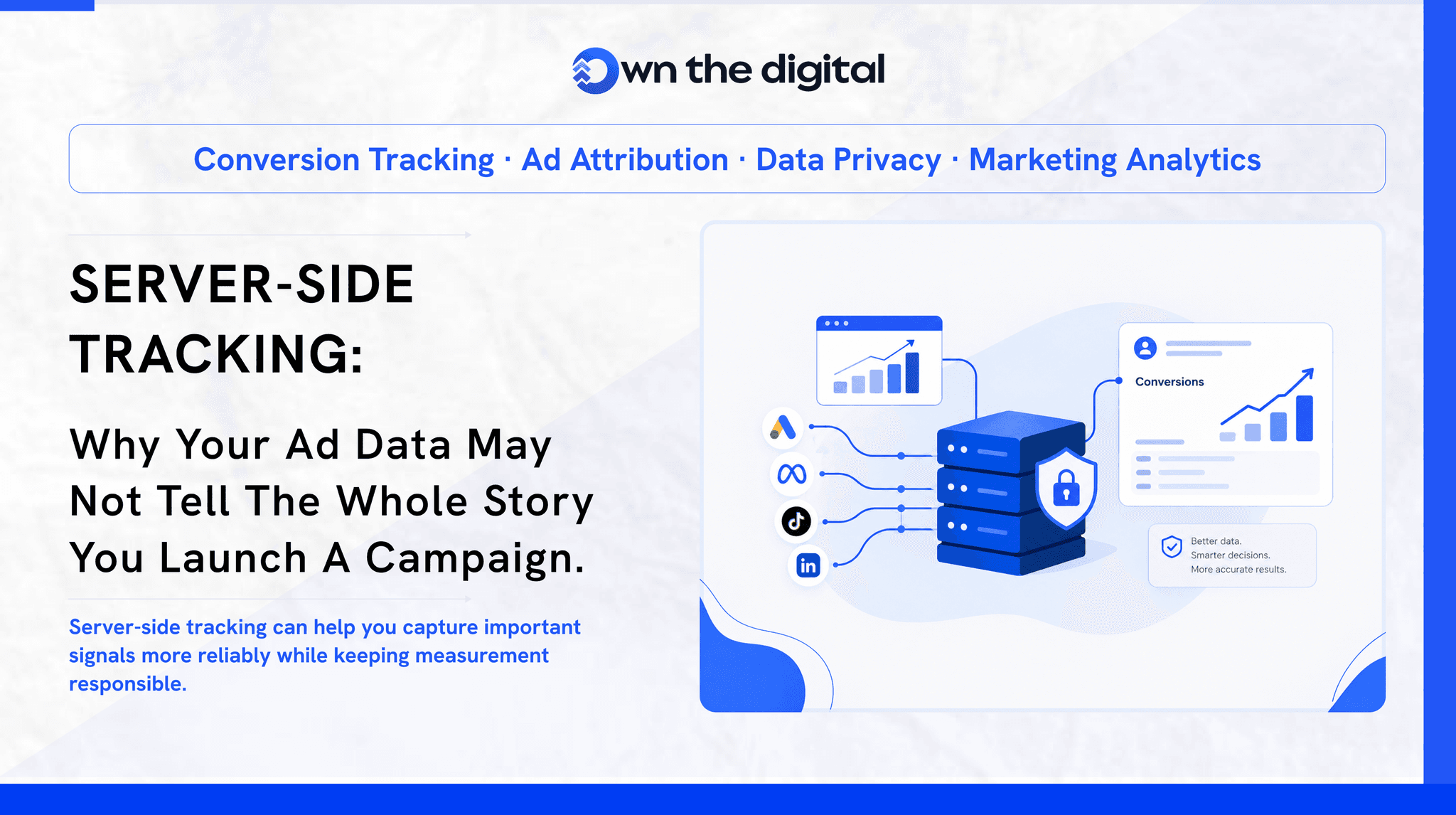
Server-side tracking can help businesses create a clearer connection between advertising activity and meaningful conversion data.
A professional digital marketing illustration representing server-side tracking, conversion data, analytics platforms, advertising systems, and business performance connected through a central server.
Server-side tracking can help businesses capture important conversion signals that browser-based tracking may miss. Learn how it works, when it makes sense, its limitations, and why better measurement starts with knowing which data to trust.
Server-Side Tracking: What Marketers Need to Know
You launch a campaign, people click on your ads, visitors arrive on your website, and some of them eventually become customers. On the surface, it seems like a straightforward customer journey. However, when you compare the numbers across your advertising platform, analytics platform, and internal business systems, you may discover that each one is reporting a different number of conversions. At that point, the real challenge is no longer simply understanding how your campaign performed. You also have to determine which data provides the most accurate picture of what actually happened.
This is one of the more frustrating realities of modern digital advertising. Businesses have access to more data than ever before, yet the customer journey between an advertisement and a completed purchase or qualified lead can still be difficult to measure accurately. The issue is not always that a campaign performed badly. In many cases, the problem is that important signals were never captured or successfully passed between the different systems involved in the customer journey.
Browsers have become more restrictive about tracking, users have greater control over cookies and permissions, ad blockers can interfere with browser-based tracking, and privacy changes have made it more difficult for advertising platforms to receive every signal they previously relied on. As a result, businesses are increasingly looking at server-side tracking as another way to capture and communicate important conversion information.
Server-side tracking is not a magic solution that suddenly makes attribution perfect. Instead, it changes where certain tracking events are processed and gives businesses another way to send important conversion signals to advertising and analytics platforms. For businesses that rely heavily on paid advertising, understanding how server-side tracking works and where it fits into a broader measurement strategy can become increasingly important.
What Is Server-Side Tracking?
To understand server-side tracking, it helps to first understand how traditional browser-based tracking works. When someone visits your website and completes an action, such as submitting a form, adding a product to their cart, or completing a purchase, tracking code running inside the user's browser can send information about that event to an analytics platform or advertising platform. This approach is generally referred to as client-side tracking.
Client-side tracking has been an important part of digital marketing measurement for many years, but it depends heavily on what happens inside the visitor's browser. If a browser blocks a tracking mechanism, a user declines certain permissions, an extension interferes with a tracking script, or a page fails to load the necessary code correctly, the event may not be recorded as expected. Privacy settings and browser restrictions can also limit the information that advertising platforms receive.
With server-side tracking, the business's server becomes another important part of the measurement process. Rather than relying entirely on the visitor's browser to send every event directly to third-party platforms, relevant information can first reach the business's own server. The server can then process the event and send appropriate information to selected advertising or analytics platforms through their supported APIs, conversion systems, or other approved integrations.
The key difference is therefore where the event is processed and how it reaches the destination platform. Instead of depending entirely on the browser to communicate a conversion, the business can use information from its own systems as another source of conversion data. This can provide greater control over the information being processed and shared while reducing some of the limitations associated with relying exclusively on browser-based tracking.
Why Are Marketers Talking About Server-Side Tracking Now?
For many years, digital advertising created the impression that almost every important customer action could be measured. Someone could click an advertisement, visit a website, complete a purchase, and the advertising platform could often connect those events. This made it easier for marketers to compare advertising spend with reported conversions and use that information to optimise campaigns.
The digital advertising environment has become more complicated. Browsers have introduced stronger privacy protections, third-party cookies have faced increasing restrictions, users can limit certain forms of tracking, and ad blockers can interfere with browser-based tracking. Mobile platforms have also introduced additional privacy controls that affect how advertising and conversion signals are collected and shared.
This does not necessarily mean that conversions have stopped happening. Instead, some of the signals used to connect those conversions back to advertising platforms may no longer be captured consistently. A customer may still purchase a product or become a qualified lead, but the advertising platform may not receive all of the information required to associate that conversion with the original marketing activity.
For marketers, this creates a significant measurement challenge. A campaign could appear to be generating fewer conversions than it actually is, or the numbers reported by an advertising platform could differ significantly from the company's internal business records. When that happens, marketing teams can end up making decisions based on incomplete information without realising that their measurement system is missing part of the customer journey.
Client-Side Tracking vs. Server-Side Tracking
The simplest way to understand the difference between client-side and server-side tracking is to consider where the conversion event is processed. With client-side tracking, the user's browser plays a central role in collecting and sending information about an action to the relevant platform. With server-side tracking, the business's server receives relevant information and can then send selected events to the appropriate platform.
Consider a customer purchasing a product from an ecommerce website. In a traditional browser-based setup, the purchase event may depend on tracking code successfully running in the customer's browser and communicating the transaction to an advertising or analytics platform. If something prevents that tracking code from working correctly, the purchase may not be recorded by the platform even though the transaction successfully occurred inside the business's own system.
With a server-side setup, the business can also use information from its own backend systems to record the purchase and communicate the appropriate conversion information to the relevant platform through an approved integration. This provides another route for important conversion data to reach the marketing ecosystem.
However, server-side tracking does not necessarily mean that browser-based tracking should be removed. In many cases, businesses use both approaches because each can provide different types of information. Browser-based tracking can help capture website interactions and other user activity, while server-side tracking can provide additional conversion information from systems that the business controls directly.
The right approach depends on the company's website architecture, customer journey, advertising platforms, conversion events, privacy requirements, consent framework, and technical capabilities. There is no universal tracking setup that is automatically right for every business.
Better Tracking Does Not Mean Tracking Everything
One of the most important things to understand about server-side tracking is that the goal should not simply be to collect as much information as technically possible. More data does not automatically create better marketing decisions. In fact, collecting unnecessary information can introduce additional privacy, security, compliance, and data-management challenges.
The objective should be to identify the events that genuinely matter to the business and send the appropriate information to the platforms that need it. For example, a business may want an advertising platform to understand that a purchase occurred so that campaign performance can be measured more accurately. That does not automatically mean that every available piece of information about the customer should be sent to the advertising platform.
This is where privacy and data governance become particularly important. Server-side tracking can provide businesses with greater control over how data is processed and what information is shared, but that control comes with responsibility. Businesses need to consider what information is necessary for measurement, what users have consented to, which platforms receive the information, how the information is stored and processed, and whether the implementation complies with applicable privacy requirements and platform policies.
A strong tracking strategy should therefore focus on responsible measurement rather than invisible measurement. The objective is to understand marketing performance while respecting the people behind the data and maintaining appropriate controls over the information being collected and shared.
How Server-Side Tracking Can Help Paid Advertising
Server-side tracking becomes particularly relevant when businesses depend on paid advertising because advertising platforms use conversion signals to understand what happens after someone interacts with an advertisement. Depending on the platform and the implementation, these signals can contribute to campaign measurement and optimisation.
If important conversion events are missing, duplicated, delayed, or incorrectly configured, an advertising platform may have less useful information available. This can make it more difficult for marketers to understand campaign performance and may affect the quality of the signals available to the platform's optimisation systems.
Server-side conversion tracking can provide another way for businesses to communicate important events using information from their own systems. Instead of relying entirely on a browser event to indicate that a purchase occurred, a business can use information from its backend systems to communicate the relevant conversion through an approved server-side integration.
This can become especially useful when the most valuable conversion does not happen immediately after the initial website interaction. Lead generation provides a good example. A potential customer may submit a form today, but the business may only determine several days or weeks later whether that person became a qualified lead or eventually generated revenue.
In this situation, the initial form submission may be useful, but the eventual qualified customer or sale may be a much more meaningful business outcome. Where the necessary data, consent, and integrations are properly configured, server-side tracking can help businesses communicate those downstream conversion events back to their advertising ecosystem.
This can create a closer connection between what happens inside an advertising account and what ultimately happens inside the business. Instead of measuring only the earliest digital interaction, marketers can potentially build a measurement framework that better reflects the outcomes the business actually cares about.
Server-Side Tracking Is Not the Same as Better Attribution
It is important to separate tracking from attribution. Implementing server-side tracking does not suddenly tell you exactly which marketing channel deserves credit for every sale. Attribution remains complicated because modern customers often interact with several marketing channels before completing a purchase.
A customer might see an advertisement on social media, search for the company on Google several days later, read a blog post, return directly to the website, and eventually complete a purchase after receiving an email. Each interaction may have played a role in the customer journey, which means there may not always be one simple answer to the question of which channel created the customer.
Server-side tracking can improve the reliability of certain conversion signals, but it does not eliminate the broader challenges associated with attribution. Marketers still need to understand how their attribution models work, what information each platform can observe, and how platform-reported results compare with actual business outcomes.
This is why more data does not automatically mean more truth. Better measurement comes from having relevant, reliable, and well-understood data rather than simply increasing the amount of information being collected.
What About Privacy?
Privacy should be an important part of any discussion about server-side tracking. Moving tracking from the browser to a server should not be viewed as a way to bypass privacy protections, consent requirements, user choices, or platform policies. Businesses still have responsibilities regarding how information is collected, processed, stored, and shared.
In some respects, server-side tracking makes data governance even more important because the business has greater control over the information being processed. That control can be useful, but it also means that businesses need to make deliberate decisions about what information should be collected and what information should be shared with external platforms.
A responsible implementation should begin by identifying the business purpose behind each conversion event. Businesses should understand what information is necessary for measurement, establish appropriate consent mechanisms and controls, review the requirements of the platforms they use, and ensure that their implementation follows applicable privacy and data-handling requirements.
The objective should be to create a measurement system that provides useful marketing information without treating privacy as an obstacle to work around. Responsible tracking should allow businesses to understand performance while respecting the choices and expectations of the people whose data is involved.
Do You Need Server-Side Tracking?
Not every business needs to immediately invest in a sophisticated server-side tracking setup. A smaller website with limited advertising activity, a straightforward customer journey, and basic measurement requirements may be able to achieve its objectives without introducing significant technical complexity.
The conversation becomes more relevant when advertising spend increases, customer journeys become more complicated, conversion information is spread across multiple systems, or advertising platforms consistently report numbers that do not match the company's internal records. Server-side tracking can also become more relevant when a business generates leads but the meaningful business outcome happens much later in the customer journey.
Instead of asking whether every business should implement server-side tracking, a more useful question is whether your current measurement setup is losing important information because it depends too heavily on the browser. If your internal systems show significantly different results from your advertising platforms, it may be worth investigating where those discrepancies are coming from before making changes to your campaigns.
There are several situations where a business may want to examine its tracking architecture more closely. These include cases where advertising platforms consistently report fewer conversions than internal systems, customer journeys extend beyond the initial website conversion, paid advertising represents a significant source of leads or sales, or important conversion events occur offline or after the initial website interaction.
It can also be worth exploring when marketing data is spread across multiple systems or when the business needs greater control over how conversion events are processed and shared. These circumstances do not automatically mean that server-side tracking is required, but they can indicate that the existing measurement setup deserves a closer review.
What Server-Side Tracking Cannot Fix
There is a temptation to treat tracking infrastructure as the solution to every marketing measurement problem, but server-side tracking cannot fix fundamental problems with a marketing strategy. It cannot turn a poorly structured campaign into a successful campaign, make an unattractive offer more compelling, or compensate for a weak landing page and unclear messaging.
It also cannot explain every reason a customer abandons a purchase or transform incomplete business data into perfect attribution. Tracking technology can improve how information is collected and communicated, but it cannot replace sound marketing strategy or accurate business data.
The foundation of the measurement system still matters. Businesses need clearly defined conversion events, consistent event naming, accurate data, appropriate deduplication, and a clear understanding of what each advertising and analytics platform is receiving.
If the underlying measurement architecture is poorly designed, moving tracking to the server will not automatically solve the problem. Without the right foundation, businesses can simply move the confusion from the browser into another part of their technology stack.
The Bigger Shift: From Counting Clicks to Understanding Customers
The most interesting part of server-side tracking is not necessarily the technology itself. It is the change it can encourage in the way businesses think about marketing measurement. Digital advertising has traditionally placed considerable emphasis on clicks, impressions, click-through rates, and platform-reported conversions.
These metrics can still provide valuable information, but businesses ultimately care about outcomes that go beyond individual clicks or impressions. They care about qualified leads, customers, revenue, repeat purchases, customer value, and sustainable growth.
The closer a measurement system can connect marketing activity with meaningful business outcomes, the more useful the resulting data becomes. This is where server-side tracking can become part of a broader measurement strategy.
Rather than implementing tracking simply because a particular technology is becoming popular, businesses should first identify the measurement problem they are trying to solve. The technology should support a clear business objective rather than become another layer of complexity within an already complicated marketing stack.
The Future of Tracking Is Not About Knowing Everything
Digital advertising is moving toward an environment where businesses cannot assume they will see every step a customer takes. Browsers, privacy controls, consent requirements, platform policies, and increasingly complex customer journeys all affect how much information can be captured and connected.
This does not mean that businesses should simply try to collect every available signal. A more sustainable approach is to identify the signals that genuinely matter, capture them responsibly, and use them to understand whether marketing activity is contributing to meaningful business outcomes.
That is where server-side tracking fits into the wider digital marketing landscape. It can strengthen the connection between a company's internal systems and the advertising platforms it relies on, provide additional conversion signals when browser-based tracking does not capture the complete picture, and give businesses greater control over how selected events are processed and shared.
However, server-side tracking is not a shortcut to perfect measurement. If your marketing data feels unreliable, it may be part of the answer, but the first step should be understanding where your current tracking breaks down, which conversions actually matter, and what information your business needs to make better decisions.
Final Thoughts
Server-side tracking is ultimately less about collecting more data and more about creating a dependable measurement framework. As browser restrictions, privacy controls, consent requirements, and increasingly complex customer journeys continue to influence digital advertising, businesses need to think carefully about where their conversion data comes from and how much confidence they should place in the numbers reported by different platforms.
A well-designed server-side tracking setup can help bridge the gap between website activity, internal business systems, and advertising platforms. It can provide additional conversion signals, support more meaningful measurement, and give businesses greater control over the information they choose to process and share. At the same time, it cannot replace strong campaign strategy, accurate data architecture, thoughtful attribution, or responsible privacy practices.
The most valuable approach is therefore not to chase more tracking simply for the sake of collecting more information. Businesses should first identify the outcomes that matter, determine where valuable signals are being lost, and then build a measurement system around the information that can genuinely support better decisions.
Ultimately, better marketing does not begin with collecting more data. It begins with knowing which data is worth trusting.
Need Better Visibility Into Your Marketing Performance?
If your advertising platforms, analytics tools, and actual business numbers are telling different stories, the problem may not necessarily be your campaigns. Your tracking setup could be making it difficult to see what is really happening across the customer journey.
At Own The Digital, we help businesses build performance marketing systems around meaningful business outcomes, including paid advertising, conversion tracking, measurement, optimisation, and digital growth. Whether you are dealing with inconsistent conversion data, unclear attribution, or uncertainty about where your marketing budget is creating value, the right measurement strategy can help you understand where the gaps are and what needs to change.
Our approach is not about adding more tools simply to create a more sophisticated technology stack. It is about understanding your existing marketing ecosystem, identifying where valuable signals may be getting lost, and creating a measurement structure that supports better business decisions.
Don't optimise your marketing based on numbers you don't fully trust. Talk toOwn The Digital about building a performance marketing setup that gives your business a clearer picture of what is actually working.