Agency vs In-House Marketing: What Does Your Business Need?
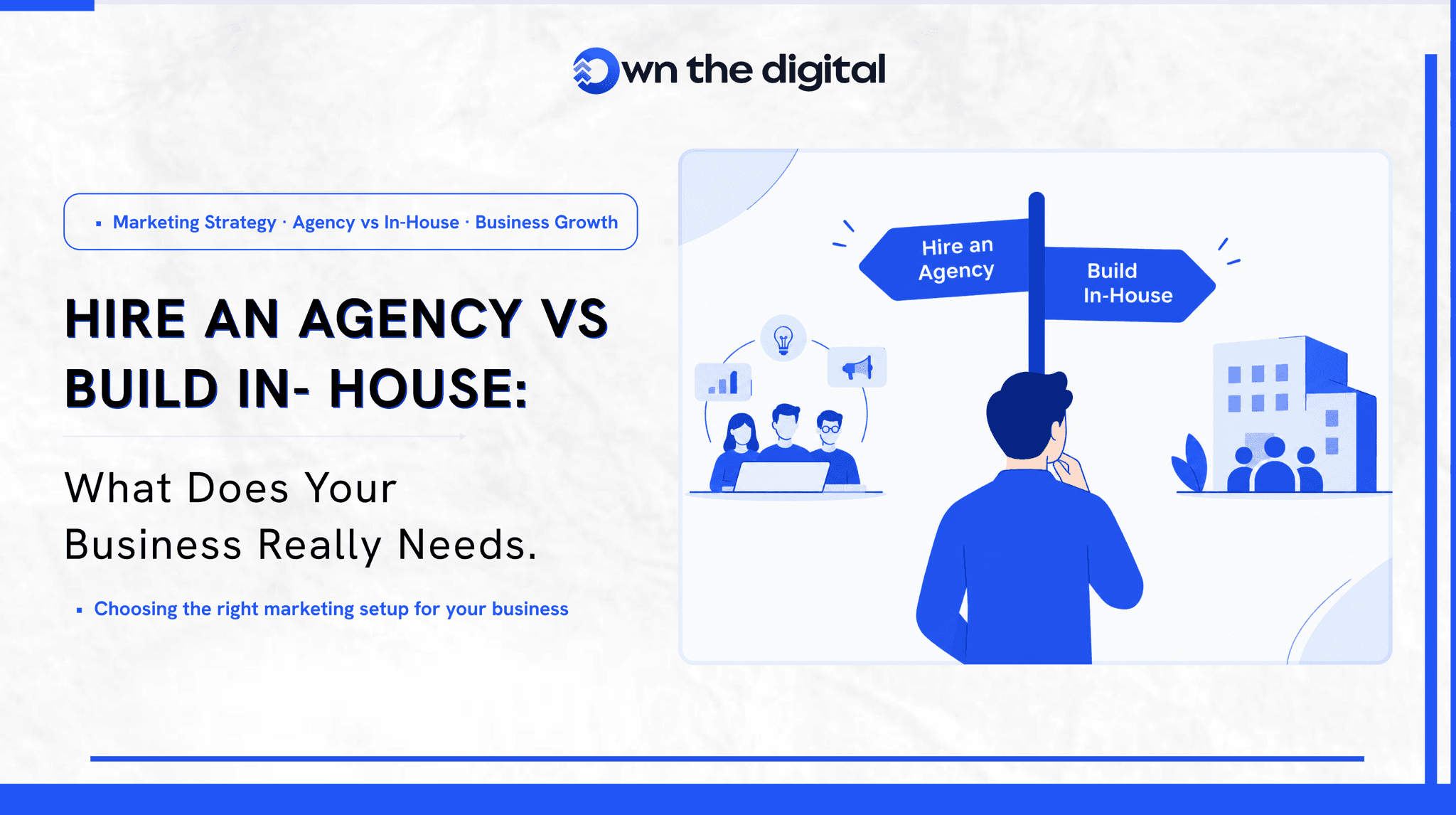
Agency vs in-house marketing: choosing the right approach for your business
A visual comparison of agency and in-house marketing models, highlighting differences in expertise, cost, flexibility, ownership, and business growth.
Should your business hire a marketing agency or build an in-house team? Explore the costs, expertise, flexibility, ownership, and hybrid options to find the right marketing structure for your stage of growth.
There is a point in almost every growing business when marketing becomes too important to handle casually. The founder who once wrote an occasional LinkedIn post is now thinking about campaigns. The person managing social media may also be answering questions about paid advertising, while someone from sales suggests content ideas between calls. A designer may help with campaigns whenever there is time. Everyone is doing a little marketing, but nobody really owns the whole picture. That eventually leads to an important business question: Should you hire a marketing agency or build an in-house marketing team?
At first, the decision may seem straightforward. You could compare an agency's monthly fee with an employee's salary and choose whichever appears more affordable. Marketing, however, does not work like a simple salary calculation. Building marketing capabilities also involves expertise, management, recruitment, training, software, tools, experimentation, mistakes, speed, and the opportunities you may miss while a new team learns what works. That is why the better question is not simply which option costs less. The more useful question is: What does your business actually need from marketing at this stage? The answer can look very different for a startup, a growing company, and an established business.
Why This Decision Feels Bigger Than It Looks
Choosing between an agency and an in-house team is not simply a decision about who will manage your social media or run your next advertising campaign. For many businesses, it becomes a decision about how they want to build their marketing function. An in-house team can feel like something that truly belongs to the company. Internal marketers become familiar with the brand, understand the people behind the business, and gradually develop an instinct for what feels right. They hear internal conversations, understand company culture, and learn details that may never appear in a brand guideline. There is also comfort in knowing that the people responsible for marketing are part of the organisation every day.
Hiring a marketing agency creates a different relationship. You bring an external team into an area that matters deeply to the business and trust them with how the company communicates with potential customers. That can feel risky, especially when the agency does not know the business yet. However, an outside perspective can also provide value. When people spend every day thinking about their own product or service, they can find it difficult to see the business from the customer's perspective. Internal teams may become so familiar with existing processes that certain assumptions stop being questioned. An external marketing team can bring a fresh perspective, challenge those assumptions, and identify problems that have become difficult to see internally.
That is why the decision deserves more thought than simply comparing two invoices. Businesses need to consider the expertise, ownership, speed, flexibility, context, and long-term requirements that come with each approach.
What Does Hiring a Marketing Agency Actually Give You?
When a business hires a marketing agency, it should not simply be buying execution. A capable agency can provide access to multiple areas of expertise without requiring the business to immediately hire a separate employee for every function. Depending on the agency and its scope, that support may include marketing strategy, content, creative production, paid advertising, SEO, copywriting, design, analytics, campaign management, and other specialised capabilities.
For a growing business, that flexibility can solve a practical problem. You may know that your marketing needs to improve, but you may not need five or six full-time specialists inside the company. Hiring several specialists at once creates a significant commitment before you fully understand what your long-term marketing structure should look like. A marketing agency can give the business access to those capabilities without requiring it to build an entire department immediately.
Agencies Can Also Help Businesses Move Faster
Speed is another factor that businesses often overlook when comparing an agency with an in-house marketing team. Suppose a company wants to launch a campaign, enter a new market, improve paid acquisition, or rethink its digital presence. Building an internal team could involve writing job descriptions, finding candidates, conducting interviews, negotiating offers, managing notice periods, onboarding new employees, and giving them enough time to understand the business. That process can take considerable time.
An agency that already has people, processes, tools, and experience in place may be able to start much sooner. That does not automatically make an agency the right choice. It simply means that speed has business value. A delayed campaign may not appear as a separate line item in a financial report, but the opportunity cost can still affect growth.
But Agencies Do Not Magically Understand Your Business
There is a reason some companies become disappointed with marketing agencies. They expect an external team to understand their business as deeply as the people who built it. That rarely happens immediately. An agency needs context. It needs to understand your customers, products or services, competitors, positioning, internal processes, and sometimes even the history behind decisions that may look unusual from the outside.
Without that context, even talented marketers can produce work that looks technically correct but feels disconnected from the business. This makes communication an important part of any agency relationship. The company still needs to provide information, feedback, access, approvals, and direction. At the same time, it should give the agency enough freedom to apply its own expertise.
A healthy agency relationship usually includes clear business and marketing objectives, access to relevant information, regular communication, clearly defined responsibilities, realistic timelines, a shared understanding of success, and enough trust for the external team to do its job. The strongest agency relationships rarely feel like the company handed over marketing and disappeared. Instead, the agency operates as an extension of the internal team while both sides remain accountable for the outcome.
Then Why Build an In-House Marketing Team?
The biggest advantage of an in-house marketing team is not simply availability. It is context. An internal marketer experiences the business while it happens. They hear what customers are asking, understand what sales teams struggle to communicate, know what the product team plans to launch, and see the conversations happening inside the organisation. Over time, that knowledge can become extremely valuable.
An in-house team can also develop a stronger sense of ownership. Marketing becomes part of the company's daily rhythm instead of something managed entirely outside the organisation. This can matter when marketing plays a central role in attracting customers, communicating value, building reputation, and supporting growth.
The Challenge of Building the Team
There is, however, an important consideration. Building an internal marketing team means taking responsibility for building that team properly. One person cannot realistically become an expert in every marketing discipline. Content, performance marketing, design, SEO, video, social media, analytics, email, and strategy all require different strengths.
A company may begin with one generalist because that seems practical. As marketing becomes more sophisticated, however, the business may discover that one person cannot handle every requirement at the expected level. The next hire may fill one gap, followed by another specialist and another tool. Eventually, someone also needs to manage the entire function. The team grows, but so does the responsibility of managing it.
That does not mean building an in-house marketing team is the wrong approach. It means businesses should understand what they are committing to when they choose to build marketing capabilities internally.
The Cost of an In-House Marketing Team Is More Than the Salary
This is where the agency-versus-in-house discussion can become misleading. Suppose an employee costs the company a certain amount per year. That figure does not represent the complete cost of building that capability. Recruitment takes time, onboarding requires resources, and employees may need training, software, equipment, management, and ongoing development. The company also needs to consider leave, replacement costs, employee turnover, and the learning period before a new hire becomes fully effective.
There is also the cost of hiring the wrong person. That cost can become particularly difficult to measure in marketing because the consequences may not appear immediately. A poorly planned campaign can consume advertising budget. Weak messaging can make a product harder to understand. Inconsistent communication can gradually affect how customers perceive a brand.
Another cost that businesses often overlook is management bandwidth. Someone inside the organisation needs to set priorities, review work, provide feedback, track performance, resolve issues, and connect the marketing team with the wider business. When comparing an agency with an internal hire, businesses should therefore consider the broader cost of building and managing the capability.
That broader calculation can include:
- Employee compensation and benefits
- Recruitment and hiring costs
- Onboarding and training
- Marketing software and tools
- Equipment and infrastructure
- Management time
- Specialist hiring
- Employee turnover and replacement costs
- Learning and experimentation
- Campaign and execution costs
An agency does not eliminate these business risks, but it can change how the company manages them. Instead of building every capability internally, the business can access an existing team and determine how much external support it needs.
Agency Fees Are Not Automatically the Expensive Option
The opposite assumption can be just as misleading. An agency's monthly fee may look larger than the salary of one employee, but comparing those numbers without comparing what each option provides does not tell the full story. One employee gives the business one person's time and expertise. An agency may provide access to several specialists with different skills.
That does not automatically make an agency the right choice. It means the comparison should happen at the level of capability rather than headcount. If a business needs a strategist, performance marketer, designer, copywriter, editor, and analyst, the useful question is not whether an agency costs more than one employee. The better questions focus on how many capabilities the business needs, how often it will use them, how quickly it needs them, and whether it has enough work to justify several full-time specialists.
- How many marketing capabilities does the business actually need?
- How frequently will those capabilities be required?
- Does the business have enough work to justify full-time specialists?
- Who will manage the internal marketing function?
- How quickly does the business need to start?
- How much internal marketing expertise already exists?
- Which functions require deep company knowledge?
- Which functions could benefit from external expertise?
Once these questions enter the conversation, the comparison becomes much more meaningful. Businesses can evaluate the structure based on what they actually need rather than making a decision based only on the visible price of an agency or employee.
Sometimes the Problem Is Not “Agency vs In-House”
There is another option that companies often overlook because they assume they must choose one side. They do not. A business can keep core marketing responsibilities in-house while bringing in an agency for specific requirements. For example, an internal team could own the brand voice, content calendar, communications, and day-to-day marketing while an external partner manages paid advertising. Another company might keep performance marketing internally but use an external partner for creative production, SEO, or a specific campaign.
This approach can work well when a company knows what it wants to own but does not want to build every capability from scratch. The business can keep important knowledge and decision-making close while using external expertise where a specialised skill or additional capacity is required.
A Hybrid Marketing Model Can Evolve With the Business
One of the biggest advantages of a hybrid marketing model is flexibility. A company might initially rely heavily on an agency because it needs expertise quickly. As the business grows, it could hire its first internal marketer. Later, it might build a larger marketing team and use external partners only for specialised projects.
The structure can change as the business changes. There is no rule that says the model chosen today must remain unchanged forever. An internal team might own strategy and brand while an agency handles execution. Alternatively, the internal team might manage daily marketing while an external partner provides specialist expertise. The important part is defining ownership clearly so that a hybrid setup does not become a situation where everyone assumes someone else is responsible.
Do Not Let “Building a Team” Become the Goal
There is also an emotional side to hiring that businesses do not always discuss. Growing companies often associate more employees with progress. Hiring someone can feel like a milestone, and creating a new department can make the business feel more established. However, a bigger team does not automatically create better marketing.
If you hire three people because you believe the company should have an internal marketing department, but you do not have enough work, direction, budget, or leadership to support them, you may create another business problem instead of solving the original one. The same principle applies to agencies. Hiring an agency because competitors appear to have one does not make sense if nobody inside the company knows what the agency should accomplish.
The decision should come from the business problem rather than from what looks like the next logical step. A marketing structure should support the company's actual goals, resources, customers, and stage of growth.
Questions to Ask Before Choosing
Before deciding between an agency, an in-house marketing team, or a combination of both, step away from the labels and examine the actual requirements of the business. The following questions can help clarify what the company needs now and what it may need over the next six to twelve months.
- What is the biggest marketing problem we are trying to solve right now?
- Do we need more people or access to more specialised expertise?
- How many marketing capabilities do we actually need?
- How quickly do we need those capabilities?
- Do we have someone internally who can manage the function effectively?
- How much company-specific knowledge does the role require?
- Do we have enough consistent work to justify a full-time specialist?
- Which responsibilities should remain close to the business?
- Which areas could benefit from an outside perspective?
- What does success look like six or twelve months from now?
These questions can reveal that the real problem is sometimes not the absence of an agency or an internal marketing team. It may simply be the absence of clear ownership. When responsibilities, goals, and expectations remain unclear, adding more people may not solve the underlying issue.
So, What Does Your Business Actually Need?
Start with your current reality rather than the answer you think you are supposed to give. If your business needs several marketing capabilities but is not ready to build a large internal team, a marketing agency can provide access to specialised expertise without requiring a full department immediately. If marketing has become central to the business and you need people who can understand the brand every day, building an in-house team may become more relevant.
If you already have a capable internal team but face a specific skills gap, an external partner can address that gap without requiring you to rebuild the entire marketing function. The right structure can also change as the company grows. A startup may value flexibility, while a growing company may need greater ownership and a mature business may need a combination of internal knowledge and external expertise.
There is no universal formula because businesses do not grow in identical ways. What works for one company at one stage can become unnecessary at another. The right approach depends on the capabilities you need, the resources available to you, the speed you require, and the role marketing plays in your broader growth strategy.
Final Thoughts
The agency-versus-in-house debate becomes easier when you stop asking which model is universally better. Instead, focus on what your business needs from marketing right now. Do you need more hands or more expertise? Do you need speed or long-term ownership? Do you need someone who already knows how to solve the problem, or are you ready to invest time in building that capability internally?
Most importantly, consider whether your current marketing structure helps the business move forward or simply keeps everyone busy. Marketing is not about having the biggest team, the most impressive agency, or the longest list of services. It is about having the right people, skills, perspective, and ownership around the problems that matter to the business.
Sometimes that means building your own marketing team. Sometimes it means bringing in an external agency. In other cases, a hybrid marketing model may provide the flexibility to combine internal knowledge with outside expertise. The right choice is not necessarily the one that looks best on an organisational chart or appears cheapest on a spreadsheet. It is the structure that gives your business the capabilities it needs at the stage it is actually in, without creating a model it is not ready to manage.
Need Help Deciding What Your Business Needs?
You do not have to build an entire marketing function before you understand what works. If you are unsure whether your business needs an in-house marketing team, an external agency, or a combination of both, Own The Digital can help you identify an approach that fits your business goals and current stage of growth.
From performance marketing and paid campaigns to strategy, creative, content, and digital growth, our team can work with you based on where your business is today and where you want it to go next. The goal is not to build a marketing setup simply because it looks right on paper. It is to create a structure that supports your business, gives your team the capabilities it needs, and helps you make better marketing decisions as you grow.
Talk to Own The Digital and explore the right marketing solution for your business.