Google Ads vs Meta Ads: Which Should You Use?
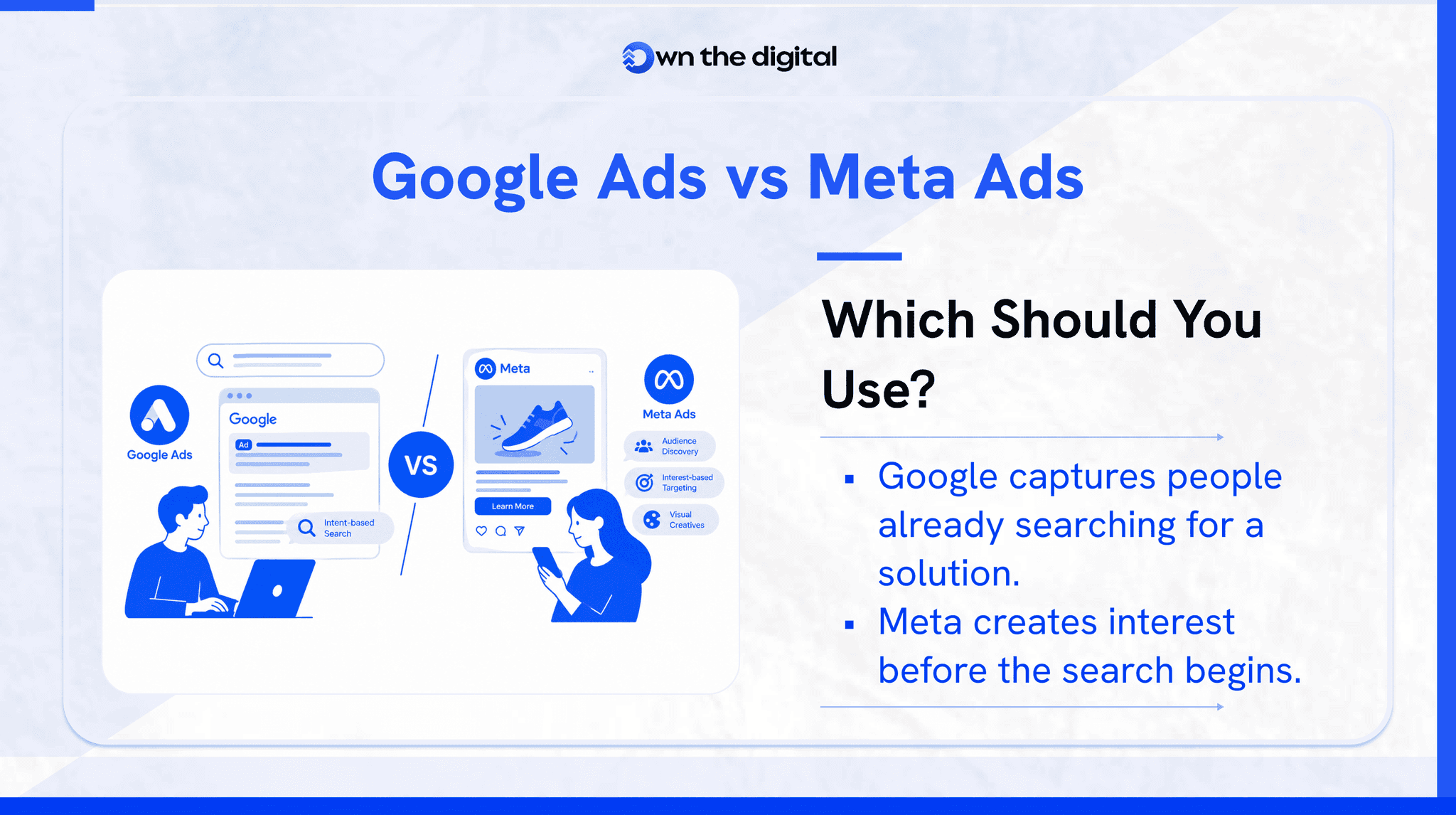
Google Ads captures existing search demand, while Meta Ads helps businesses discover and engage potential customers.
A digital marketing comparison illustrating Google Ads search campaigns and Meta Ads on Facebook and Instagram, highlighting the differences between search intent, audience discovery, and paid advertising strategies.
Google Ads vs Meta Ads: discover how the platforms differ in search intent, audience targeting, advertising costs, creative strategy, lead generation, and customer acquisition. Learn when to use each platform and how combining both can support your business growth.
Google Ads vs Meta Ads: Which Should You Use?
When a business decides to invest in paid advertising, one of the first questions that comes up is whether the budget should go into Google Ads or Meta Ads. It sounds like a straightforward platform comparison, but the two channels operate around fundamentally different user behaviours.
Someone searching Google for "best CRM software for small business" has already expressed a need through their search. Someone scrolling Instagram and seeing an ad for a CRM tool may not have been looking for software at all. Both users can eventually become customers, but the path that gets them there is different.
That difference is what makes the Google Ads vs Meta Ads conversation more useful than simply comparing clicks, impressions, or cost per lead.
Google Ads vs Meta Ads: The Fundamental Difference
Google Ads is primarily built around capturing existing demand, particularly through Search campaigns. A person types a query into Google because they want information, a product, a service, or a solution. The advertiser has an opportunity to appear when that intent already exists.
Meta Ads, across platforms such as Instagram and Facebook, are primarily designed around audience discovery and interruption. Users are not necessarily opening Instagram because they want to purchase something. They are there to consume content, interact with people, or explore interests, and an advertisement enters that experience.
This creates an important distinction between the two platforms. Google can place a brand in front of someone at the moment they actively express a need, while Meta can introduce an offer before a person has consciously started searching for it. Neither behaviour is inherently more valuable. It depends on whether the business needs to capture demand that already exists or create interest among people who may have a reason to care.
For example, someone searching for "dentist near me" is already signalling a specific requirement. A dental clinic can use Google Ads to compete for that search. On Meta, the same clinic could reach people based on location, demographics, interests, previous interactions, or other audience signals and introduce services such as dental check-ups or cosmetic treatments before the user searches for a provider.
Google Ads Works Around Intent
Search intent is one of Google Ads' biggest advantages. The user's query gives advertisers information about what they are trying to find. A search such as "buy running shoes online" is very different from "how to choose running shoes." The first query suggests a stronger commercial intent, while the second is more informational.
This makes keyword selection an important part of Google Ads strategy. Advertisers can choose the searches they want to compete for, control bids, structure campaigns around different themes, and send users to landing pages relevant to their query. The closer the relationship between the search, advertisement, landing page, and offer, the easier it becomes to create a coherent path from intent to action.
However, intent does not automatically make Google Ads profitable. High-intent keywords can also be highly competitive. Popular commercial searches can attract multiple advertisers, which can push click costs upward. A campaign can therefore generate clicks from people who genuinely need the product and still struggle to produce profitable conversions if the offer, landing page, tracking, or economics do not work.
Meta Ads Creates Demand Differently
Meta Ads approaches targeting from another direction. Instead of waiting for users to search for a particular solution, advertisers can introduce products, services, offers, and ideas to audiences based on available targeting signals and platform behaviour.
Creative plays a much larger role here because the advertisement has to earn attention before it can communicate its proposition. A search user has already typed something related to the product. A person scrolling through Instagram has not necessarily given the advertiser that opening. The visual, first few seconds of a video, headline, offer, and overall presentation need to create enough curiosity for the user to stop.
This makes Meta particularly useful for businesses where visual storytelling, demonstrations, social proof, offers, lifestyle positioning, or product discovery influence buying behaviour. It can also be useful for remarketing, where people who have already interacted with a brand can be reached again with relevant messaging.
The challenge is that a large audience does not automatically translate into a large number of customers. Meta can generate inexpensive reach and traffic while still producing weak commercial outcomes if the audience, creative, offer, or conversion journey is poorly aligned.
Google Ads vs Meta Ads: Targeting Is Different
The targeting mechanisms on the two platforms reflect their different roles. Google Search allows advertisers to target users based heavily on what they are actively searching for. Keywords, search terms, locations, devices, audiences, and other campaign settings can influence who sees an advertisement.
Meta gives advertisers a different set of audience signals. Campaigns can be built around characteristics, interests, behaviours, custom audiences, website activity, customer data, and similar signals where available and permitted by the platform's current policies. The platform can then use its delivery systems to find people within the defined audience who are more likely to complete the selected objective.
In simple terms, Google often starts with the question, "What is this person looking for?" Meta often starts closer to, "Who might be interested in this?"
That difference becomes particularly important when choosing a channel for a new product. If people already understand the category and actively search for it, Google may have existing demand to capture. If the product is new, visually compelling, unfamiliar, or dependent on awareness, Meta may provide more room to introduce the idea to potential customers.
Which Platform Costs Less?
There is no universal answer to whether Google Ads or Meta Ads is cheaper. Comparing the two purely through CPC or CPM can be misleading because the platforms perform different jobs.
Meta often allows advertisers to reach large audiences at relatively low costs, but cheap impressions do not necessarily mean cheap customers. Google clicks can cost more because advertisers are competing for searches with commercial intent, but those clicks may come from users who are further along in their decision process.
The metric that matters depends on the business objective. For a lead-generation campaign, cost per qualified lead may be more useful than cost per click. For ecommerce, contribution margin and customer acquisition cost may matter more than traffic volume. For an awareness campaign, reach and frequency may have a legitimate role.
Looking only at the cheapest click can encourage the wrong allocation of budget. The real comparison is therefore not "Which platform has lower costs?" It is "What does each rupee of advertising spend produce after the click?"
Creative Matters More on Meta
Google Search ads still require strong copy, but the user has already initiated the interaction through a query. Meta advertising puts greater pressure on the creative because the ad competes with everything else in the user's feed.
A product may need a strong visual demonstration. A service business may need a problem-led video. An ecommerce brand may need creator-style content, customer proof, product comparisons, or an offer that makes the interruption worthwhile. The creative has to communicate quickly because the audience did not arrive with a specific commercial question.
This also means Meta campaigns often need a steady supply of creative variations. The same ad can stop performing as audiences become less responsive to it. Testing different hooks, formats, messages, demonstrations, offers, and visual treatments can become an important part of campaign management.
Google Ads Needs More Than Keywords
The opposite mistake is assuming Google Ads is simply a matter of finding high-volume keywords and bidding on them. A search campaign can fail even when the keywords are relevant.
Consider a business bidding on a keyword that receives thousands of searches but sends those users to a generic homepage. The advertisement may earn clicks, but the landing experience does not necessarily continue the conversation started by the search. If the user searched for a specific service and lands on a page that forces them to figure out where to go next, conversion efficiency can suffer.
Google Ads therefore works best when keyword strategy, ad messaging, landing pages, conversion tracking, offer positioning, and follow-up are connected. The search query creates the opportunity, but everything after the click determines how much of that opportunity the business captures.
When Should You Use Google Ads?
Google Ads can make sense when there is existing search demand around the product or service. Local services, professional services, software categories, ecommerce products, and many established business categories can benefit when potential customers actively search for what they offer.
It can be particularly useful when the business knows the problems customers are trying to solve and can map those problems to relevant search terms. A company selling accounting software, for instance, may be able to target searches related to accounting software, invoicing tools, GST software, or other specific requirements depending on its market and offering.
However, search volume alone should not determine whether a campaign should exist. The economics of the product, competition, conversion rate, average order value, customer lifetime value, and ability to serve the resulting demand all matter.
When Should You Use Meta Ads?
Meta Ads can be useful when the business needs to create awareness, introduce a product, generate demand, retarget existing audiences, or use creative to influence consideration. Consumer brands with visually demonstrable products often have a natural opportunity to use the feed environment to their advantage.
It can also be useful when the audience is identifiable through meaningful signals even if people are not actively searching for the product. A brand selling a niche lifestyle product does not necessarily have to wait for potential customers to type the exact product category into Google. It can introduce the product through content designed to make the audience recognise a problem, desire, or opportunity.
The quality of the creative and offer becomes especially important here because the advertiser is asking users to change their behaviour rather than simply responding to an existing search.
Google Ads vs Meta Ads for Lead Generation
Lead generation is where the distinction between the platforms can become especially interesting. Google can capture users who are already searching for a service, while Meta can generate interest among audiences who may not have begun looking for a provider.
A B2B software company, for example, might use Google Search to capture people actively comparing software providers while using Meta to distribute educational content, case studies, or thought-leadership creatives to relevant audiences. The same company could then retarget people who visited its website or interacted with its content.
This is why treating Google and Meta as competing platforms can sometimes create an unnecessary limitation. Depending on the business model and available budget, they can operate at different stages of the same customer journey.
Google Ads vs Meta Ads: You Don't Always Have to Pick One
The strongest paid media strategy is not necessarily the one that chooses one platform and ignores the other. Google and Meta can play different roles within the same acquisition system.
Meta can introduce the brand, create initial interest, distribute creative, and build remarketing audiences. Google can capture people who later search for the brand, product, category, or service. Existing customers can potentially be re-engaged through both channels with appropriate messaging and audience strategies.
The important part is understanding the role assigned to each platform. If every channel is judged by the same metric, the business can end up cutting a channel that was performing a different job. A Meta campaign generating awareness should not necessarily be evaluated in exactly the same way as a Google Search campaign capturing high-intent queries.
The Better Question Is Not Google or Meta
The Google Ads vs Meta Ads debate becomes much more useful when the question changes from "Which platform is better?" to "Where does our customer demand come from?"
If customers actively search for the problem you solve, Google may provide a direct route to that existing demand. If customers need to discover the product, understand the problem, or be persuaded through creative, Meta may have a different role to play. If the business has enough budget and a customer journey that supports both, using the platforms together may create more opportunities than forcing a choice between them.
At Own the digital, paid advertising should be connected to what happens beyond the ad itself. A campaign can have a strong CTR and still generate poor business results. A platform can produce inexpensive leads that sales cannot qualify. Another campaign can have a higher acquisition cost but bring customers with stronger lifetime value.
The useful comparison is therefore not Google versus Meta in isolation. It is search intent versus audience discovery, click cost versus acquisition economics, and platform metrics versus actual business outcomes. Once those factors are visible, the decision about where to spend becomes a marketing question rather than a platform preference.