Answer vs Solution: Why Data Alone Isn’t Enough
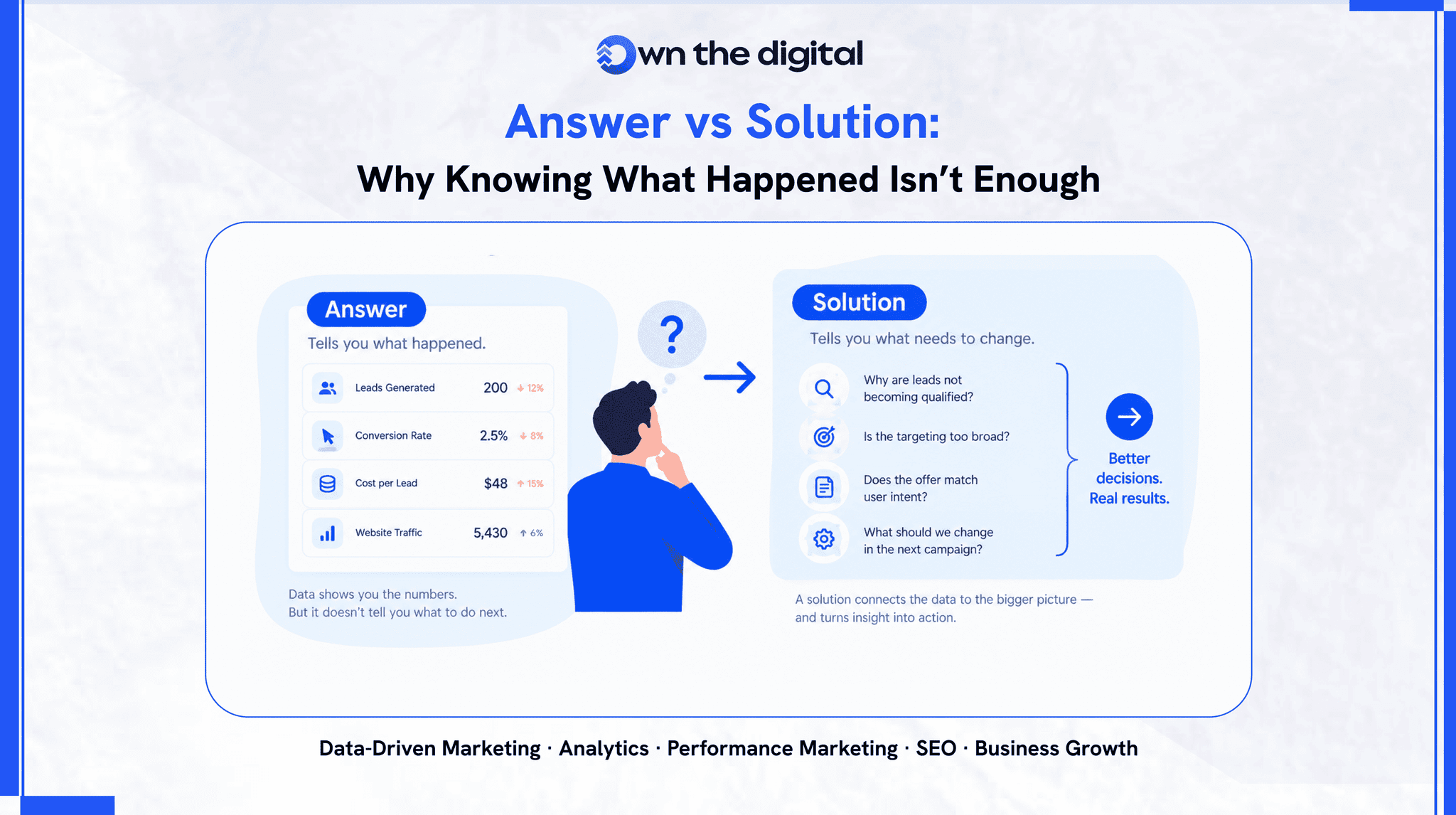
Marketing data provides insights, but meaningful solutions come from understanding root causes and taking action.
A conceptual illustration of how digital marketing analysis can move beyond performance reporting to identify underlying problems and develop actionable strategies that improve SEO, lead quality, conversions, and business outcomes.
Digital marketing provides plenty of answers through analytics, advertising reports, and SEO data. But knowing what happened is not enough. Learn how to identify root causes, develop actionable marketing solutions, and turn data into meaningful business outcomes.
Digital marketing gives businesses more answers than ever before. With modern analytics tools, advertising platforms, search performance reports, and customer relationship management systems, businesses can track almost every stage of their marketing activities. They can see how many people clicked an advertisement, how much traffic a landing page received, where visitors dropped off, which keywords generated conversions, and how much they spent to acquire each lead.
However, having access to all this information does not automatically mean a business understands what needs to change. There is an important difference between identifying what happened and finding a practical way to improve the outcome. A report can explain why a campaign performed below expectations, but the real value of that report depends on whether the insights lead to better decisions and measurable improvements.
This is where the difference between an answer and a solution becomes important. An answer helps explain the current situation, while a solution addresses the underlying reason and creates a path forward. In digital marketing, the objective should not simply be to understand performance but to use that understanding to improve business results.
An Answer Tells You What Happened. A Solution Changes What Happens Next.
Imagine a business running paid advertising campaigns for a high-value service. After a month, the marketing team discovers that the campaign generated 200 leads, but only a small percentage became qualified sales opportunities. The initial conclusion might be that the campaign is generating low-quality leads, which is a useful observation but not a complete solution to the problem.
The next step is to understand why people who appear interested in the service are not becoming valuable business opportunities. The advertisements might promise something broader than the company actually offers, the landing page might attract people looking for cheaper alternatives, or the audience targeting might be too wide. The lead form could also be designed to maximise submissions rather than identify serious prospects, creating a gap between marketing performance and actual sales potential.
Each of these possibilities requires a different response, which is why identifying the real cause matters more than simply reporting the outcome. Once the team understands what is attracting unsuitable leads, it can refine the messaging, improve targeting, adjust the landing page, or introduce better qualification questions. The answer identifies the problem, but the solution changes the process that created it.
The Problem With Optimising for Answers
Marketing dashboards can create an illusion of progress because they make it easy to measure improvements in individual metrics. A campaign manager might report that click-through rate increased by 18%, another campaign might achieve a lower cost per click, and a landing page might record a higher conversion rate. These results can all be accurate without necessarily indicating that the business is becoming more profitable or attracting better customers.
A higher conversion rate does not automatically mean better customer quality, just as a lower cost per click does not guarantee more efficient customer acquisition. More leads do not necessarily produce more revenue, and increasing website traffic does not always indicate that demand for a product or service is growing. When marketing teams focus exclusively on visible metrics, they risk improving numbers that have little connection to the outcomes the business actually needs.
For example, reducing the number of fields in a lead form may increase submissions because visitors can complete it more quickly. However, if the removed fields previously helped identify serious prospects, the campaign could generate more leads while making the sales team's job more difficult. The reported conversion rate would improve, but the quality of the sales pipeline might deteriorate.
The more useful question is whether those additional submissions created valuable opportunities and contributed to business growth. Marketing performance should therefore be evaluated through the relationship between activity, lead quality, customer acquisition, and revenue rather than through isolated metrics alone.
Marketing Problems Usually Have More Than One Layer
Most marketing problems are more complicated than they initially appear in a dashboard. When a campaign experiences a declining conversion rate, the immediate assumption might be that the advertisements have become less effective. However, the underlying cause could involve changes in audience behaviour, a weaker offer, increased competition, a shift in search intent, or a landing page that no longer matches what visitors expect to find.
Technical factors can also influence the results. A slower website, a confusing checkout process, broken tracking, or changes to conversion measurement can affect either the actual customer experience or the way performance is reported. Making changes to the advertisements without investigating these possibilities could waste budget while leaving the real problem unresolved.
A more effective approach is to move from symptom to cause and then to intervention. The symptom identifies what the data shows, the cause explains why the problem exists, and the intervention addresses the conditions responsible for the outcome. This process helps marketing teams avoid spending weeks treating visible symptoms while the underlying business issue continues to affect performance.
More Data Does Not Automatically Mean Better Decisions
One of the biggest misconceptions in modern marketing is that better decisions simply require more data. Businesses now have access to search behaviour, website analytics, advertising reports, customer relationship management data, heatmaps, customer interactions, and attribution models. Each source can provide useful information, but collecting more information does not necessarily make the decision-making process clearer.
If a company knows that thousands of people visited a landing page but cannot determine whether those visitors match its target audience, additional traffic data may have limited practical value. Similarly, a strong click-through rate might suggest that an advertisement is attracting attention, but without understanding what visitors do after clicking, the business cannot confidently assess whether the campaign is generating meaningful opportunities.
The objective should be to identify the information needed to answer an important business question rather than collect every possible metric. Instead of asking what the dashboard says, marketing teams should ask what decision the available information can support, what uncertainty remains, and what additional evidence would help them choose the right action.
This change in perspective makes marketing analysis more purposeful. Data becomes useful not because a business has more reports to review, but because those reports help it make informed decisions about budgets, audiences, content, customer experiences, and growth opportunities.
A Good Marketing Solution Connects the Metric to the Business
Marketing metrics exist within a larger business system. A click leads to a landing page, a landing page encourages an action, and that action may generate a lead. The lead might then become a sales conversation, a new customer, and eventually a source of revenue, repeat business, or referrals. Each stage influences the value of the stage before it, which makes it risky to optimize one part of the process without understanding what happens next.
For instance, a campaign designed to maximize lead volume may appear successful when it generates a large number of form submissions. However, if the business needs qualified prospects who are likely to purchase, total submissions are an incomplete measure of success. The marketing team needs to understand which leads progress through the sales pipeline and which campaign activities contribute to actual revenue.
The same principle applies to ecommerce businesses. Reducing cost per purchase can be beneficial, but the cheapest acquisition is not necessarily the most valuable if those customers spend very little, return products frequently, or never purchase again. Looking at customer value, average order value, repeat purchases, and profitability can provide a more accurate picture of campaign performance.
A meaningful marketing solution therefore starts by identifying the business outcome that needs improvement and then investigating the factors preventing that outcome. Once the objective is clear, metrics become tools for evaluating progress rather than goals that exist independently of business performance.
The Same Thinking Applies to SEO and Search
The difference between an answer and a solution is particularly important in search engine optimisation. Suppose a company discovers that a competitor ranks above it for an important keyword. The ranking report provides a clear answer about the current search landscape, but copying the competitor's content or publishing another article around the same keyword may not improve the company's position.
The next step is to understand why the competing page performs better. The investigation might involve search intent, content quality, topical relevance, internal linking, website structure, competing pages, backlinks, or technical SEO issues. It should also consider whether the existing page provides the information users expect when they search for that particular term.
Ranking is the visible outcome, while understanding the reasons behind the ranking is the strategic work. Depending on the findings, the solution could involve improving the content, restructuring the page, strengthening internal links, resolving technical problems, building relevant authority, or reconsidering whether the keyword is worth pursuing based on its commercial value.
This approach prevents SEO teams from treating every ranking decline as a reason to publish more content. Instead, they can focus on the specific changes most likely to improve search visibility, attract relevant visitors, and support the business objectives behind the campaign.
Stop Asking What Went Wrong. Ask What Needs to Change.
A post-campaign report can explain what happened, but a useful marketing strategy should also explain what needs to happen next. Every significant insight should eventually lead to a practical decision, whether that means adjusting a budget, refining an audience, improving a landing page, revising a content strategy, or investigating a weakness in the customer journey.
If qualified leads are falling, the appropriate response may be to investigate lead quality, audience intent, and qualification criteria instead of immediately increasing the advertising budget. If paid traffic is growing but revenue remains unchanged, the business should examine the journey after the click and identify where potential customers are losing interest. If organic traffic increases without meaningful conversions, it may be necessary to assess whether the content attracts people whose needs align with the company's products or services.
Similarly, when an advertisement receives strong engagement but generates few sales, the problem may extend beyond the creative itself. The offer, targeting, landing page, pricing, and overall customer experience could all influence the final result. Investigating these factors helps the team develop a response based on evidence rather than making changes simply because a metric looks disappointing.
The goal is not to produce a more impressive explanation of past performance. It is to identify an explanation that supports a better decision and creates a realistic opportunity for improvement.
The Best Marketing Questions Often Come After the Answer
An answer should be the beginning of meaningful analysis rather than the end of the discussion. When cost per lead increases, the next step is to investigate what caused the increase. When the conversion rate drops, the team should determine whether the change relates to traffic quality, the offer, the user experience, or measurement. When website traffic rises but revenue remains flat, the business needs to understand whether visitors are relevant and whether the customer journey is helping them take the next step.
This process of asking why encourages marketing teams to move beyond the visible metric and examine the business conditions behind it. It also makes reporting more valuable because the discussion shifts from describing past performance to identifying opportunities, prioritising actions, and evaluating whether those actions produce meaningful results.
Ultimately, digital marketing is not simply about producing reports that explain the past. It is about using information to make better decisions, improve customer experiences, and achieve stronger business outcomes. An answer provides information about the current situation, while a solution gives that information direction through a clear and actionable response.
When marketing teams understand this distinction, dashboards become what they should have been all along: tools that support better business decisions rather than destinations in themselves.
Turn Marketing Insights Into Meaningful Business Results
Understanding what happened is only the first step toward improving digital marketing performance. The real opportunity comes from identifying the reasons behind the numbers, recognising what is holding the business back, and building a strategy that connects marketing activity with measurable outcomes. Whether the challenge involves SEO, paid advertising, lead generation, or conversion optimization, the focus should always be on finding the right solution rather than simply reporting the problem.
Looking to turn your marketing data into a strategy that drives real business growth?Get in touch with our team to discuss your digital marketing goals, identify opportunities for improvement, and develop a practical approach focused on better leads, stronger conversions, and measurable results.