Ads on ChatGPT: What It Means for Performance Marketing
How conversational AI could reshape search behaviour, advertising, and performance marketing.
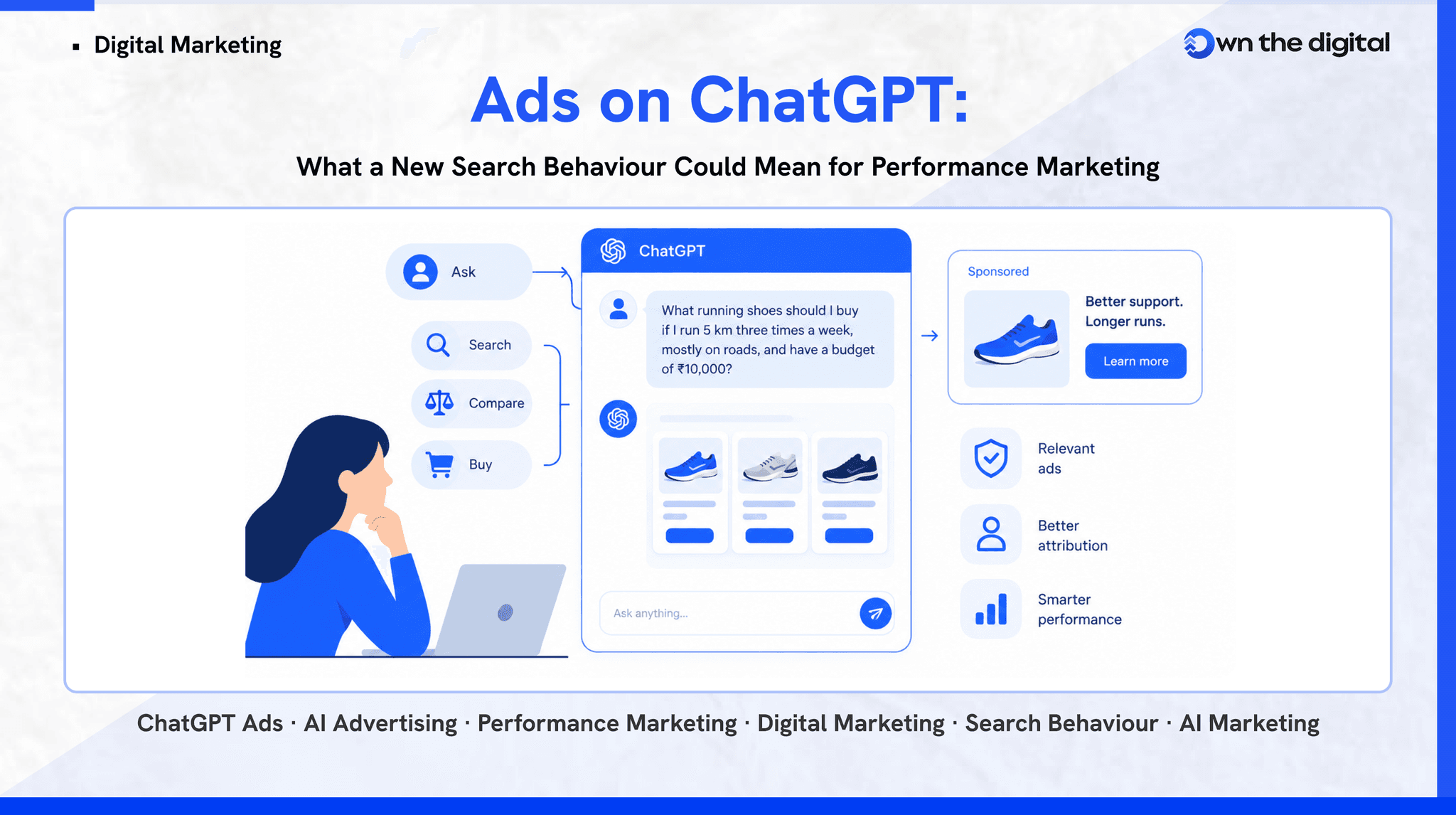
Conceptual illustration showing conversational AI, digital advertising, consumer search behaviour, and the changing role of performance marketing as people increasingly use AI assistants to research and evaluate products.
Ads on ChatGPT could change how people discover products, compare options, and make purchasing decisions. Explore what conversational AI could mean for performance marketing, attribution, trust, and brand discoverability.
For years, digital advertising has followed a fairly simple principle: be present where people are already looking. Google gave brands opportunities to appear when someone searched for a product, service, or answer. Meta allowed advertisers to reach people based on interests, behaviours, demographics, and the content they engaged with. Over time, marketers became skilled at reading these signals, understanding user intent, building audiences, and deciding how much a click or conversion was worth. AI is beginning to change that environment. As conversational AI becomes part of how people research products, compare options, solve problems, and make decisions, advertising inside these experiences raises a different question for marketers. It is no longer only about where people search. It is also about where people ask, explain, compare, and seek advice. If platforms such as ChatGPT continue developing advertising capabilities, brands may eventually have another environment where consumer intent and context become commercially valuable.
The Search Box Is Becoming a Conversation
Traditional search usually starts with a short query. Someone might type “best running shoes under ₹10,000” into a search engine, browse through the results, open several websites, compare products, and eventually make a decision. Conversational AI changes the shape of that journey because users can explain their situation instead of reducing it to a few keywords. A person might ask, “What running shoes should I buy if I run five kilometres three times a week, mostly on roads, and have a budget of ₹10,000?” That interaction contains much more context. The user is not simply looking for pages that contain certain words. They are describing a need and asking for help with a decision.
For marketers, that creates a different kind of environment to understand. The opportunity may not be about placing another banner in front of a potential customer. It may be about understanding what advertising looks like when the surrounding experience revolves around a conversation. The value of that environment will depend heavily on what the user wants to accomplish during that interaction. A person who asks a detailed question may provide more context about their needs than someone who enters a short search query.
Why ChatGPT Could Become Interesting for Advertisers
The potential appeal of advertising on AI platforms goes beyond audience size. The nature of the conversations may be even more important. People use AI tools for activities that often sit closer to the consideration stage of a purchase. They may ask for product comparisons, software recommendations, travel ideas, business solutions, educational resources, service options, or explanations of unfamiliar products. For performance marketers, these interactions can reveal useful signals about intent and context.
Someone scrolling through Instagram may match the profile of a potential customer because of their interests or online behaviour. Someone asking an AI assistant to compare two products is already doing something different. They are actively working through a decision. That does not automatically make AI a better advertising environment than search or social media. It does, however, make it a distinct type of consumer interaction that marketers need to understand before assigning a commercial value to it.
Advertising Here Cannot Simply Copy Google Ads
One of the biggest mistakes brands could make would be to treat AI advertising as another version of search advertising. Search ads often benefit from a relatively direct connection between a query and commercial intent. When someone searches for “buy office chairs online,” the commercial context is fairly clear. A conversational prompt can be much more complicated. A user might say, “I work from home and my lower back starts hurting after sitting for several hours. What should I change about my setup?” Products may relate to that conversation, but the person has not directly asked to buy anything.
That creates an important difference between helping someone solve a problem and trying to sell something to them. If advertising becomes part of conversational AI experiences, relevance will likely matter enormously. A promotion that feels disconnected from the user's question could damage the experience that made the platform useful in the first place. For advertisers, this could push creative strategy beyond headlines, images, and calls to action. The context surrounding the user may become an important part of how marketers think about relevance.
The Real Opportunity May Be Intent, Not Impressions
Digital advertising has spent years focusing on impressions, clicks, click-through rates, conversions, acquisition costs, and related performance metrics. Those measurements will remain useful, but AI-powered environments could introduce another layer: contextual intent. Consider two customers who eventually purchase the same product. One sees an advertisement while casually scrolling through social media. The other spends ten minutes asking questions about different solutions, comparing features, discussing a budget, and narrowing down their options before encountering a relevant commercial recommendation.
Both customers may eventually click an advertisement, but the paths that brought them to that point are very different. This difference deserves attention from performance marketers. The potential value of AI advertising may not come from generating more clicks alone. It could come from reaching people while they are actively working through a decision. That shift could influence audience strategy, creative development, landing-page messaging, offers, and measurement.
But There Is a Major Trust Question
There is another part of this discussion that marketers cannot overlook: trust. People often use AI assistants because they expect useful, relevant answers. That creates a different relationship from the one users have with traditional advertising environments. When someone sees a sponsored post while browsing social media, they generally understand that they are inside a commercial environment. A conversational experience can feel more like a direct exchange, which may make the distinction between information, recommendation, and promotion more sensitive.
For brands, transparency will therefore matter. If an advertisement appears inside an AI-powered environment, users should be able to recognise that it represents paid placement. Otherwise, the bigger problem may not be a weak click-through rate. It could be a decline in trust. Once trust becomes part of the performance equation, short-term optimisation may not tell the whole story. A campaign can produce clicks while still weakening the relationship between a brand and its audience.
Performance Marketers Will Need to Rethink Attribution
AI-assisted discovery also creates a measurement challenge. Imagine that a customer first discovers a product while talking to an AI assistant. Later, they search Google, watch a YouTube review, encounter a Meta advertisement, return to the company's website, and complete a purchase. Which interaction deserves credit for the sale? Traditional attribution models already struggle with journeys that cross several channels. AI-assisted discovery could make those journeys even harder to understand.
A customer may not remember exactly where the original idea came from, and the AI interaction may influence the decision without producing a conventional advertising click. Marketers may therefore need to look beyond last-click attribution and examine the wider decision journey. Instead of asking only which platform generated the conversion, businesses may need to understand which interactions helped move the customer from curiosity to consideration and eventually to purchase. That is a harder question, but it can provide a more complete view of how people actually make decisions.
This Could Change How Brands Think About Being Discoverable
SEO taught businesses that visibility in search results can influence how customers discover products and services. AI introduces another form of discoverability. A brand may not always need to appear as a traditional search result. It may need to become relevant when someone asks about a particular problem, category, product, or solution. This creates an interesting connection between paid media, content, brand positioning, and organic visibility.
The brands that benefit from AI-driven discovery may not simply be those with the largest advertising budgets. Strong products, useful information, clear positioning, and credible expertise can also influence whether a brand fits naturally into a conversation. For marketers, this could make the boundaries between advertising, content, SEO, and brand building even less distinct. A business may need to think about how it appears across the entire customer decision process rather than treating each channel as a separate activity.
What Should Brands Do Right Now?
The answer is not to immediately move advertising budgets away from Google or Meta and place them into a new channel. The advertising landscape changes too quickly for that kind of reaction. Instead, brands can start by paying closer attention to how their customers use AI. What questions are they asking before they contact a business? What products or services are they comparing? Which objections are they trying to resolve? What problems are they trying to solve before they ever visit a company website?
These questions can reveal valuable information about how customers approach a decision. Performance marketers can use those insights to improve more than advertising campaigns. They can influence landing pages, content strategy, offers, creative messaging, product positioning, and conversion journeys. The smarter approach is to understand the behaviour first and decide how to scale it later.
The Bigger Shift Is Already Underway
The interesting part of advertising on ChatGPT is not simply the possibility of another advertising channel. The bigger development is the potential change in how people discover information and make decisions. For years, brands competed to appear when people searched. Then they competed to appear while people browsed social platforms, watched videos, read articles, and explored online communities. AI introduces another environment where people can explain what they need in their own words and ask for help navigating a decision.
That changes the context in which marketing takes place. For Own The Digital, the important takeaway is to avoid viewing AI advertising as simply another placement to buy. Instead, marketers should treat it as another consumer behaviour to understand. Platforms will change, advertising formats will develop, and measurement methods will evolve. The fundamental performance-marketing question, however, will remain familiar: can your brand show up when it is genuinely relevant to what the customer is trying to accomplish? If AI becomes part of that moment, marketers need to understand the behaviour, the expectations, and the opportunities before the space becomes crowded.
Final Thought
AI could change more than where advertisements appear. It could change the relationship between discovery, consideration, and purchase. A customer who asks an AI assistant a detailed question may reveal far more about their situation than someone who enters a short search query or casually scrolls through a social feed. That does not guarantee better advertising results, but it gives marketers a new type of behaviour to study.
Brands that pay attention to these changes can make better decisions about content, positioning, customer journeys, and future media strategies. The opportunity is not simply to find another place to advertise. It is to understand how customers are changing the way they look for answers.
Start Preparing Your Performance Marketing Strategy
For businesses, the rise of conversational AI is a reason to examine how customers discover, evaluate, and choose products or services online. At Own The Digital, we can help you look at these changes from a performance-marketing perspective and identify where evolving search and discovery behaviours could affect your strategy. Whether you are reviewing your paid media approach, improving your customer journey, strengthening your content strategy, or exploring new opportunities in AI-driven discovery, the right strategy starts with understanding how your audience behaves.
Want to understand what changes like these could mean for your brand's performance marketing strategy? Let's talk.